Ruling Party Accelerates Reform Legislation... Stalemate in Cooperation, Burden on President Lee [100 Days of Lee Administration]
- Input
- 2025-09-10 18:27:15
- Updated
- 2025-09-10 18:27:15
Relationship between Ruling and Opposition Parties
Ruling Party Plans to Handle Government Reorganization
Opposition Strongly Opposes Policy and Legislative Monopolization
Stalemate Deepens Amid Ruling Party Dominance
Seeking Political Restoration to Lead Bipartisan Cooperation
Ruling Party Plans to Handle Government Reorganization
Opposition Strongly Opposes Policy and Legislative Monopolization
Stalemate Deepens Amid Ruling Party Dominance
Seeking Political Restoration to Lead Bipartisan Cooperation
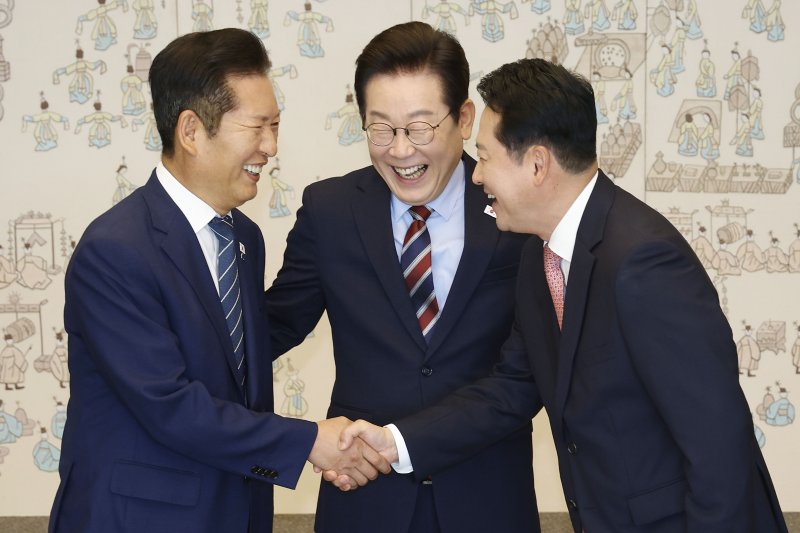
According to political circles on the 10th, the Democratic Party has selected 224 bills to be prioritized in this regular session of the National Assembly, focusing on four key tasks: livelihood, growth, reform, and safety. In particular, the Democratic Party plans to quickly process bills for the so-called three major reforms: prosecution, judicial, and media reforms. Democratic Party leader Jeong Cheong-rae has repeatedly emphasized the completion of legislative work related to the three major reforms in this regular session of the National Assembly. Previously, the ruling party and the government confirmed a reorganization plan to abolish the Prosecutor's Office and split it into the Public Prosecution Office and SCIO, in line with the principle of separating investigation and prosecution. The Public Prosecution Office will be under the Ministry of Justice, and the SCIO will be under the Ministry of Public Administration and Security. Once the amendment is passed and finally promulgated, it will be implemented one year later. Furthermore, the government is also working on reorganizing economic ministries by splitting the Ministry of Strategy and Finance into the Ministry of Finance and Economy and the Planning and Budget Office, and establishing the Planning and Budget Office. Additionally, the government has confirmed the contents of the Government Organization Act amendment, which reorganizes the Financial Services Commission into the Financial Supervisory Commission (FSC) and places the Financial Supervisory Service and the Financial Consumer Agency as public institutions under the FSC. The Democratic Party plans to handle the Government Organization Act amendment with these contents at the plenary session on the 25th.
Regarding judicial reform, the government is pursuing amendments to the Court Organization Act and the Criminal Procedure Act, including increasing the number of Supreme Court justices and introducing a judge evaluation system. It is also pushing for the forced passage of the amendment to the three major special prosecutor laws and the establishment of a special court for rebellion. Media reform is being pursued again with the Media Arbitration Act, which was discussed in the 21st National Assembly. The government is considering introducing a punitive damages system that determines compensation amounts as multiples of the damage amount in cases where damage occurs due to false or manipulated reports by the media.
In response to these actions, the opposition People Power Party is strongly opposing, claiming that the government and the ruling Democratic Party are monopolizing policy and legislation. Although President Lee Jae-myung proposed 'cooperation' and discussed creating a livelihood economic council to handle common pledges of the ruling and opposition parties during a luncheon meeting with ruling and opposition party leaders on the 8th, the strong confrontation between the ruling and opposition parties continues. Both Jeong Cheong-rae and Jang Dong-hyuk, leaders of the People Power Party, are showing strong tendencies, deepening the political stalemate. In the 'ruling party dominance, opposition minority' structure, the People Power Party is conducting filibusters (unlimited debate to delay proceedings under the National Assembly Act) on every contentious bill pushed by the Democratic Party, and is also responding with outdoor protests and forums containing public opposition messages.
The Democratic Party is emphasizing 'clearing up rebellion' towards the People Power Party and is not stopping its strong drive, while the People Power Party is also strongly opposing, indicating that the process of handling key bills in this regular session of the National Assembly is likely to experience difficulties for some time. In particular, the confrontation between the ruling and opposition parties is expected to intensify during the National Assembly audit scheduled for October. The tense confrontation between the ruling and opposition parties, with cooperation seeming distant, is also a burden on President Lee. It is crucial to draw bipartisan cooperation on major national tasks. A political circle insider stated, "To find a clue to political restoration, efforts need to be made not only in setting relations with the opposition party but also with the ruling party."cjk@fnnews.com Choi Jong-geun Reporter