Youth Employment Slump Continues... Record High 'Resting' in Their 30s
- Input
- 2025-09-10 10:43:37
- Updated
- 2025-09-10 10:43:37
[Financial News] Although the number of employed people increased by about 160,000 in August this year compared to a year ago, the mood varied by age group. The youth employment rate decreased, and the record high 'resting' in their 30s was recorded in August. On the other hand, the number of employed elderly and their employment rate are on the rise. As the age decreases, employment indicators worsen due to changes in the population structure, while the baby boomer generation, those aged 60 and over, are actively entering employment.
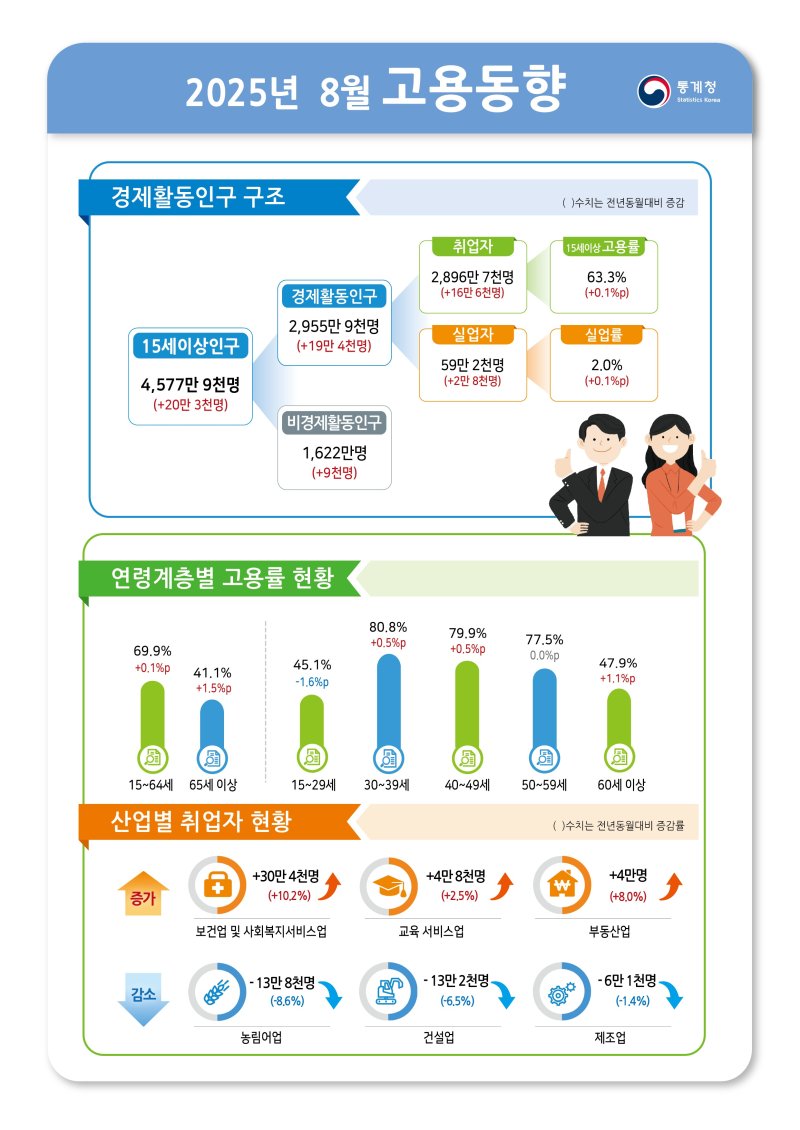
According to the 'August Employment Trends' by Statistics Korea on the 10th, the number of employed people aged 15 and over last month was 28.967 million, an increase of 166,000 from a year ago. The number of employed people turned to a decrease of 52,000 last December and recorded 100,000 for four consecutive months from January this year. In May, it recorded 245,000, surpassing 200,000 for the first time in 13 months, but △183,000 in June △171,000 in July, and fell back to 100,000 for three consecutive months.
By age group, the employment situation varied. The number of employed people decreased by 219,000 among young people aged 15-29. Employment also decreased for those in their 40s (73,000) and 50s (38,000). On the other hand, the number of employed people aged 60 and over increased by 401,000.
The employment rate also showed a contrast with the overall employment rate soaring, centered on the middle-aged, while the youth rate fell for 16 consecutive months since May last year. The youth employment rate was 45.1%. On the other hand, △30s 80.8% △40s 79.9% △50s 77.5% △60 and over 47.9%, except for those in their 50s, the employment rate increased.
Among the economically inactive population, the number of 'resting', who do not work or seek jobs, was 328,000 in their 30s, the largest on record for August. The increase in resting among those in their 30s was analyzed as an increase in the economically inactive population as childcare and housework decreased. The resting among the youth was 446,000, decreasing for four consecutive months but maintaining over 400,000.
The proportion of 'unemployed+job preparation+resting' experiencing job difficulties among the youth was 1,037,000 in August. It is 13.1% of the youth population. It increased by 0.5%p compared to the same month last year, and by 0.7%p compared to August 2023.
An official from the Ministry of Strategy and Finance said, “The decrease in youth resting is due to the base effect of the significant increase last year, and the increase in resting among those in their 30s is due to the continuation of the resting population from their 20s to their 30s. Also, there is a state of temporary resting due to active job changes.” He continued, “It is difficult to evaluate that the employment indicators have deteriorated just because the resting among those in their 30s has increased,” adding, “The population in their 30s is increasing, and the increase in employment exceeds this, and the employment rate has also increased.”
Kong Mi-sook, Director of Social Statistics at Statistics Korea, said, “The youth employment rate has fallen for 16 consecutive months as the decrease in information and communication, professional science, and technology has expanded,” adding, “The recent preference for experienced workers and frequent recruitment is disadvantageous to the youth.” She continued, “Considering the decrease in the youth population, the employment rate is still negative, so the situation is not good,” adding, “In their 30s, childcare and housework among the economically inactive are decreasing significantly. The delay in marriage and childbirth is reducing the proportion of childcare and housework, and increasing the resting factor.”
By industry, the 'employment slump' in manufacturing and construction continued. The number of employed in manufacturing decreased by 61,000, marking a decline for 14 consecutive months. The number of employed in construction also decreased by 132,000, continuing a 16-month decline. Agriculture, forestry, and fisheries also decreased by 138,000, marking a decline for 7 consecutive months. The domestic construction slump is not easily resolved, and externally, the adverse effects of tariffs from the United States are hindering employment recovery. Agriculture, forestry, and fisheries also saw a decrease in the number of employed due to weather factors such as rain and aging.
[email protected] Choi Yong-jun Reporter