[fn Editorial] Ruling Party and Business Circles' Consecutive Meetings, Meaningless Without Echo
- Input
- 2025-09-09 18:17:31
- Updated
- 2025-09-09 18:17:31
Ruling Party Leader Proposes 'Let's Meet Every Quarter'
Reflect Corporate Voices in Policy
Reflect Corporate Voices in Policy
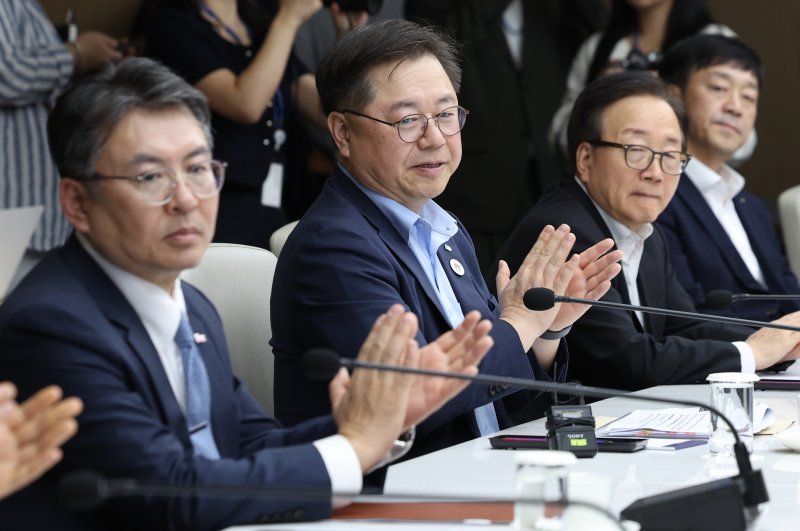
Since President Lee's inauguration, the interaction between the government, the ruling party, and the business community has increased significantly. President Lee unusually met with major group leaders and heads of economic organizations to hear their opinions less than ten days after his inauguration. When the issue of tariffs from the United States arose, President Lee also held a series of private one-on-one meetings with business leaders. There have been several meetings between the Democratic Party and the business community. At the policy meeting hosted by the Korea Chamber of Commerce and Industry on the 8th, Democratic Party Leader Jeong Cheong-rae attended and even proposed "Let's meet every quarter."
While it is extremely desirable for businesspeople, the government, and the ruling party to frequently meet and coordinate opinions, the problem lies after the meeting. On this day, the Democratic Party's KOSPI 5000 Special Committee and Economic Penal Mitigation TF team, which met with the business community, also held a similar meeting at the end of June. At that time, they held a meeting stating they would listen to the business community's opinions ahead of handling the amendment to the Commercial Act.
However, the content proposed by the business community was not reflected at all, and the ruling party pushed through and passed the amendment. The Democratic Party leader said when meeting with the business community, "We will support companies so they can have confidence in future growth," but the result was completely different. Criticism that it was an event to build justification ahead of enforcing the bill is inevitable.
The government and the ruling party have repeatedly contradicted their words and actions while verbally advocating for corporate-led growth. Management has become precarious, as if walking on thin ice, due to the amendment to the Commercial Act passed without guaranteeing corporate defense rights. The Yellow Envelope Act also contains numerous provisions that could cause great confusion in the industrial field, prompting a flood of appeals from the business community for reconsideration, but they were ignored. Already, there are successive cases of subcontractor unions demanding improved treatment from primary contractors. Concerns about indiscriminate strikes and lawsuits that could occur once the law is enforced are immense. The Hyundai Motor union breaking its seven-year strike-free record is not unrelated to the Yellow Envelope Act.
The meeting between the business community and the ruling party should show results that help corporate management. If it is merely for appeasing companies, the meeting itself is meaningless. The ruling party must take the lead in quickly supplementing the Yellow Envelope Act and preparing institutional measures to defend management rights. Introducing poison pills that issue new shares to major shareholders at prices lower than market value and differential voting rights that grant more voting rights to specific shareholders is urgent. Easing the excessive scope and severity of the breach of trust crime must also be accelerated. There are over 300 regulations that hinder growth into larger companies. These are issues that the business community has explained to the political world and requested solutions for. Meetings without echo are unnecessary.