[fn Editorial] Need to Expand Renewable Energy but Avoid Radical and Rapid Moves
- Input
- 2025-09-09 18:17:28
- Updated
- 2025-09-09 18:17:28
Discussion on the 6th Renewable Energy Plan Begins
Excessive Carbon Reduction Burdens Companies
Excessive Carbon Reduction Burdens Companies
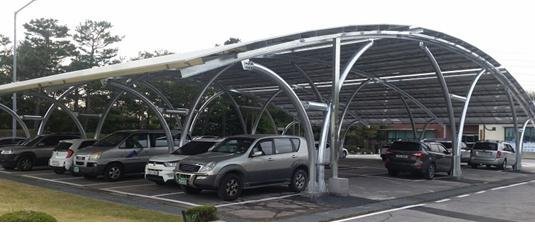
The expansion of renewable energy is an unavoidable path to adhere to international agreements on greenhouse gas reduction. The Lee Jae-myung government is sure to significantly raise the greenhouse gas reduction target (NDC) for 2035 compared to 2018, from 40% in 2030. The power generation sector will also be affected. As of last year, the share of renewable energy in power generation was 10.6%, and the target for 2034 according to the 5th Basic Plan for Renewable Energy is 25.8%.
The establishment of the Ministry of Climate Environment and Energy despite controversy can be seen as a strategy for expanding renewable energy. In the 6th Basic Plan, it is clear that the share will be raised further from 25.8%. The Ministry of Environment presented four drafts of the 2035 NDC to the National Assembly's Special Committee on Climate Crisis on the 8th: mid to high 40%, 53%, 61%, and 67%. They aim to increase it by up to 27 percentage points from 2030. The 40% range is the Ministry of Industry's proposal, while the other three are the Ministry of Environment's proposals.
The problem is that the government's greenhouse gas reduction and renewable energy expansion targets are too high. Although the highest proposal of 67% from the Ministry of Environment will not be decided, the addition of government reorganization adds to the companies' concerns. If the energy policy leadership shifts to the Ministry of Climate Environment and Energy due to reorganization, the 2035 NDC is very likely to exceed 50%. Especially, the Ministry of Environment's 67% proposal is higher than the proposals of ruling party lawmakers submitted to the National Assembly.
In a country like ours, where the manufacturing industry with high carbon emissions is significant, radical and rapid energy policies can impose a heavy burden on companies. The industry's response that the Ministry of Environment's 67% proposal is tantamount to shutting down steel mills and petrochemical plants is by no means excessive.
The government's energy policy transition and reorganization could also affect nuclear power generation. Nuclear power, as a carbon-free energy source, will not see a reduction in its share. However, if the Ministry of Climate Environment and Energy, which emphasizes regulation, focuses its policy on renewable energy and leads nuclear policy, it cannot be guaranteed that new nuclear power plant construction will not become difficult and that the nuclear ecosystem will not be destroyed, leading to a second phase-out of nuclear power.
Renewable energies such as solar and wind have become the main culprits of environmental destruction, such as digging up intact mountains or covering lakes. In a country like ours with limited land, it is an energy that cannot be increased indiscriminately. The reason why Germany and Taiwan, which had pursued nuclear phase-out policies, are rebuilding and restarting nuclear power plants is because they have reaffirmed the advantages of nuclear power.
Power generation policies for carbon reduction should focus on expanding nuclear power rather than renewable energy. Moreover, as electricity usage surges with the future spread of artificial intelligence (AI) and electric vehicles, it will be difficult to meet the demand increase with unstable renewable energy supply. Energy policy should prioritize industry over the environment. Once established, it is difficult to change easily, so it must be decided very carefully. This is even more so when recalling the harm caused by the Moon Jae-in government's nuclear phase-out policy over the past five years.