[Exclusive] "Salary received once a month → twice a month" Ministry of Strategy and Finance discusses diversification of salary cycle
- Input
- 2025-09-09 14:02:53
- Updated
- 2025-09-09 14:02:53
[Financial News] A government research service result has been announced, suggesting that a change is needed in Korea's salary culture, which is accustomed to receiving salaries once a month. The analysis indicates that if the salary cycle is diversified, such as receiving salaries weekly like in advanced countries, it could increase the satisfaction of non-regular and low-income workers and boost consumption, which is a pillar of GDP growth. The Ministry of Strategy and Finance plans to continue discussions with relevant ministries, seeing that there is a demand from workers for a more segmented salary payment method, but it drew a line that it cannot force companies to do so.
'Fixed Monthly Salary System, Disadvantageous to Non-Regular Workers and Youth'
The Ministry of Strategy and Finance received the results of the 'Research on Overseas Cases of Salary Payment Cycle and Diversification Plan' research service commissioned to the Policy and Legislation Research Institute on the 9th.
Previously, in July last year, the Ministry had reviewed the introduction of an advanced country-style salary payment system (twice a month, weekly pay, etc.) through the 'Dynamic Economy Roadmap'. This research is an extension of the review at that time. At that time, shortening the salary cycle to stimulate consumption was considered as the domestic economy was entering a recession, and there was also an intention to facilitate the cash flow of office workers.
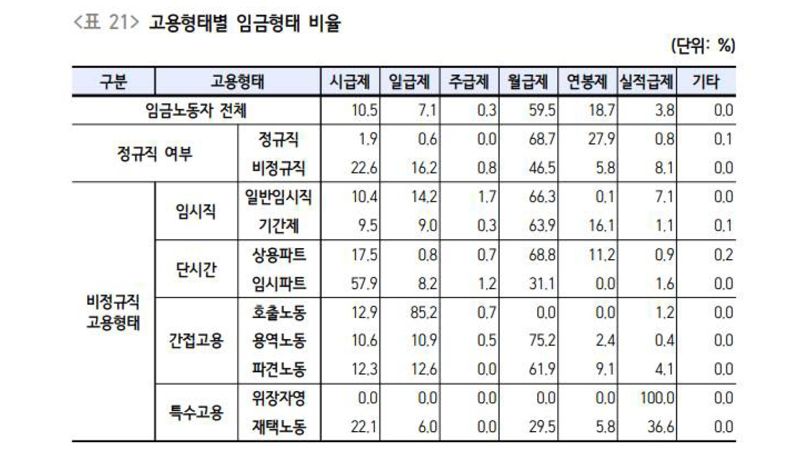
The research proposed changing Korea's conventional monthly salary payment method. This is because frequent cash is needed to maintain a living when working conditions are unstable. According to a survey of 300 workers conducted by researchers in April this year, 95% of regular workers were subject to the monthly salary system, and 68% of them preferred it. On the other hand, the preference rate for the monthly salary system among non-regular workers was only 41%, with a higher preference for the semi-monthly salary system (17.9%). Among daily workers, 45.5% preferred the monthly salary system, while the highest preference was for weekly pay (22.7%).
A significant number of non-regular and daily workers had experience relying on credit cards or loans due to a lack of living expenses before payday, and they answered that their psychological stability would increase if the salary cycle was shortened. The uniform salary payment does not meet the diverse needs of reality.
Corporate Burden and System Improvement are Major Challenges
The problem is that changing the salary cycle acts as a burden on companies as it requires a transition to an enterprise-wide management system.
In a survey conducted in April with 100 corporate representatives, 67.4% of respondents cited the increase in administrative burden as the biggest obstacle to diversifying the salary cycle.
The current Labor Standards Act stipulates that 'payment should be made on a fixed date at least once a month', so not only the monthly salary system but also the semi-monthly and weekly pay systems are legally possible. However, due to administrative, cultural, and systemic factors, the monthly salary system is fixed. According to the research, only 17.9% of domestic wage workers in 2020 chose hourly, daily, or weekly pay.
The research suggested that the government should provide incentives and support for institutional settlement to companies to diversify the salary cycle. It is necessary to provide tax benefits, consulting support for small and medium-sized enterprises, and subsidies for the introduction of related technologies to reduce the administrative and financial burden on companies.
Additionally, it proposed the 'on-demand salary' method, where workers can immediately withdraw their salary using fintech such as apps when needed. The intention is to reduce the burden of changing the salary system on companies with technology. Furthermore, since changing the salary cycle involves legal procedures such as revising employment contracts and work rules between employers and employees, government policy promotion is also necessary.
The Ministry of Strategy and Finance stated that it has no immediate plans to introduce a system for diversifying the salary cycle.
A representative from the Ministry said, “The Ministry of Employment and Labor is responsible for the related laws, so discussions between ministries are necessary. The research results have been delivered to the Ministry of Employment and Labor,” and added, “Social consensus is needed for the diversification of the salary cycle.” They continued, “The research aims to remind that the monthly salary system is not a universal system in foreign cases,” and added, “Since changing the salary cycle incurs costs for companies, preliminary discussions are necessary.”
Economic experts emphasize that diversifying the salary cycle is necessary in the long term to stimulate consumption. This is because if the salary cycle is shortened, workers' consumption can be more efficient. Although this research started during the Yoon Suk-yeol administration, it is still meaningful at the current time when consumption promotion measures such as the 'People's Livelihood Recovery Consumption Coupon' are being pursued.
The research service results also cited overseas cases, analyzing that if the salary cycle is shortened, consumption increases and is evenly distributed without concentrating on specific days. It was also pointed out that if salary day concentration leads to consumption concentration on specific days, it could result in a decline in service quality.
junjun@fnnews.com Choi Yong-jun, Hong Ye-ji reporters