"Special Prosecutor Law is Unconstitutional" Yoon's Side Requests Constitutional Review... Legal Community "Low Possibility of Acceptance"
- Input
- 2025-09-09 12:53:42
- Updated
- 2025-09-09 12:53:42
Yoon's side claims, "Against the principles of separation of powers, warrant system, and exceptionality"... Claims of unconstitutionality
"It will be difficult to recognize the necessity to stop trials conducted dozens of times"
"It will be difficult to recognize the necessity to stop trials conducted dozens of times"
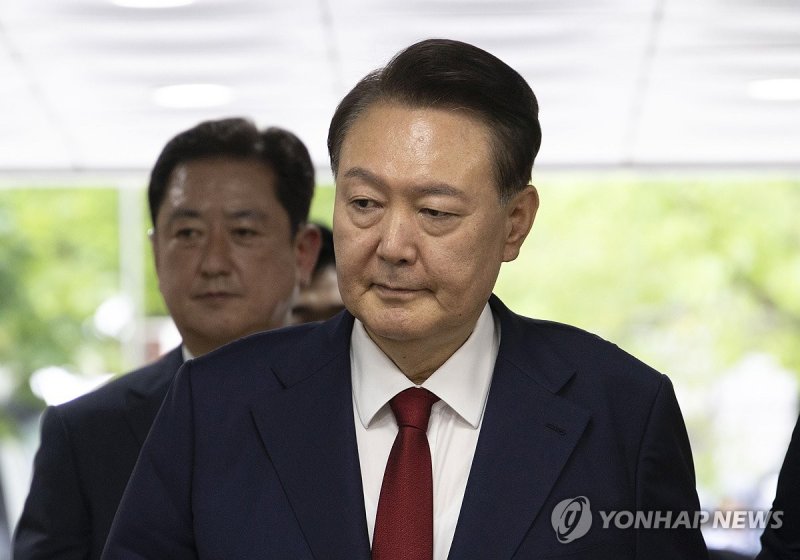
[Financial News] Yoon Seok-yeol's former presidential legal team has filed a request for a constitutional review, claiming that the special prosecutor law violates the constitution. The legal community believes that since the Constitutional Court has already ruled in similar cases that it is not unconstitutional, it is unlikely that the court will accept the request and refer the case to the Constitutional Court. If the court accepts the request, the trial will be halted until the Constitutional Court's decision on the constitutionality is made, but it is expected that halting the trial will be difficult in practice.
According to the legal community on the 9th, Yoon's side submitted a request for a constitutional review to the Seoul Central District Court Criminal Division 25 (Chief Judge Ji Gwi-yeon) handling the case of charges of being the head of a rebellion. The legal team also filed a constitutional complaint.
The legal team pointed out three major issues with the current rebellion special prosecutor law. They argued that the legislative branch's involvement in the executive branch's exclusive authority of investigation, excluding a specific party in appointing a special prosecutor, violated the principle of separation of powers. The provision allowing for the viewing, copying, and submission of presidential records with the consent of more than three-fifths of the National Assembly was claimed to exclude the warrant system concerning searches and seizures. Additionally, the provision allowing for the transfer of ongoing cases to the special prosecutor for the purpose of maintaining prosecution was said to contradict the principles of complementarity and exceptionality of the special prosecutor. Furthermore, they argued that the broadcasting of special prosecutor case trials, repetitive investigations, and media briefings infringed on the defendant's right to a fair trial.
The court will review the request and decide whether to proceed with the constitutional review. This procedure examines the constitutionality of a law applied to a case on trial if it affects the outcome. If accepted, the trial will be suspended until the Constitutional Court's judgment. However, the legal community believes it is unlikely that the request will be accepted. It is interpreted that it is difficult to recognize unconstitutionality to the extent of halting trials conducted dozens of times.
A lawyer who is a former chief judge stated, "The exclusion of a specific party in recommending a special prosecutor may not be problematic if it has a legitimate purpose, and the content regarding the viewing of presidential records was already conducted in past special prosecutor cases, so the basis is somewhat weak," adding, "The provision related to case transfer may be necessary considering the need for focused investigation by the special prosecutor. It is not easy to halt trials conducted dozens of times and refer the judgment to the Constitutional Court based on these arguments alone."
A lawyer who is a former Supreme Court research judge also said, "The principle is that the recommendation right for a special prosecutor is decided by majority vote, so it cannot be said to be a flawed system," and "It is difficult to see the transfer for maintaining prosecution by the special prosecutor as unconstitutional, as it is hard to judge that the prosecution maintenance of numerous past special prosecutors was wrong."
In fact, the Constitutional Court has previously ruled that similar special prosecutor law constitutional review cases were not unconstitutional. In February 2019, the Constitutional Court unanimously decided that the provision of the National Assembly's decision to exclude the ruling party and allow only two opposition parties to recommend special prosecutor candidates in the state affairs manipulation special prosecutor law did not violate the constitution. At that time, the Constitutional Court judged that "unless the National Assembly's decision is clearly arbitrary or significantly unreasonable, it should be respected as legislative discretion." It also stated that considering the circumstances where the president could be included as a subject of investigation and the various supplementary measures to ensure the independence of the special prosecutor, it was not easy to see the exclusion of the ruling party as unjustified.
In the constitutional complaint related to the BBK special prosecutor law in 2008, a similar judgment was made. The Constitutional Court stated that the purpose of the special prosecutor system is in its function of power control, and it is not against the separation of powers for the legislative branch to independently decide on the introduction of a special prosecutor. At that time, the provision that designated already indicted cases as subjects for reinvestigation and trial involvement was also not accepted as "infringing on the right to a fair trial."
[email protected] Choi Eun-sol Reporter