[Report] "No coding needed..." GS Hackathon, Non-majors solve problems with 'AI tools'
- Input
- 2025-09-08 16:20:24
- Updated
- 2025-09-08 16:20:24
Huh Tae-soo Chairman "Combination of field knowledge and AI"
Largest hackathon event ever
AI tools created by employees, shared company-wide
Largest hackathon event ever
AI tools created by employees, shared company-wide
[Financial News] "I will complete it without giving up."
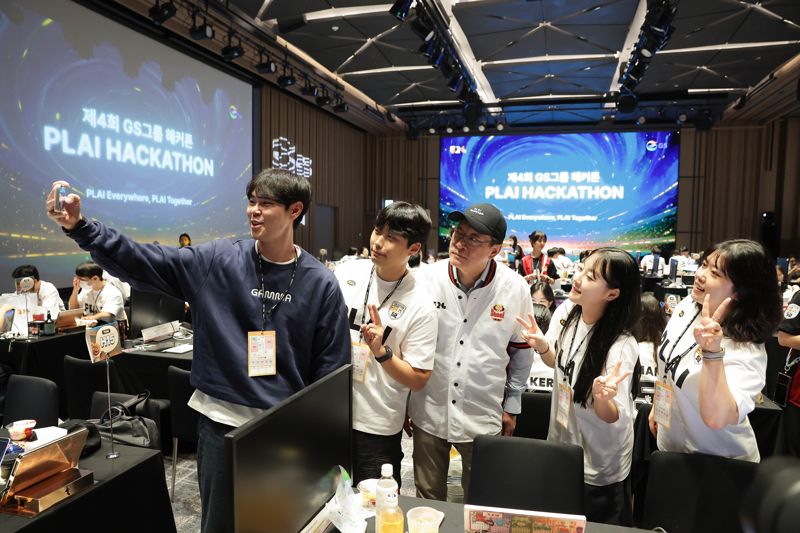
At the '4th GS Group Hackathon' held at the Westin Seoul Parnas on the 8th, 428 employees of GS Group and its affiliates shouted this in unison. On this day, participants opened their laptops, continued discussions, defined problems in their fields, and implemented solutions using generative AI-based tools.
At the center of this hackathon is GS's self-developed AI transformation (AX) platform 'MISO'. This tool allows employees without programming knowledge to easily implement code and web screens using only natural language.
Lee Jong-ho, a senior at GS Caltex, said, "Even as a non-major, I was able to follow along after just one online lecture," and "I wanted to automate the repetitive procedures of notifying partners during construction orders with the AI platform through MISO."
Participants worked on AI-based problem-solving using MISO alongside Vercel's VibeCoding tool 'v0'. The scale of the hackathon is also the largest ever. With 428 offline participants, the total number of participants, including the remote league, was 837 (256 teams). It is evaluated as having expanded into a collaborative experiment with the participation of 10 external institutions.
This attempt by GS is an extension of the 'field autonomy-based digital transformation' strategy emphasized by Chairman Huh Tae-soo. Chairman Huh emphasized, "Future growth is difficult with only traditional material industries such as oil, petrochemicals, and gas," and "The combination of digital technology and traditional technology will determine GS's future."
The fact that AI utilization continues with voluntary company-wide participation without any prizes or prize money is also noteworthy. Chairman Huh said, "We prioritize employee convenience over business feasibility," and "If field problems that could not be solved in the past are improved with AI, customer experience will eventually improve."
GS plans to build an internal 'marketplace (sharing platform)' to share these digital assets among affiliates. Kim Jin-ah, an executive director at GS, said, "Voluntary sharing among some affiliates is already taking place," and "Discussions are underway to systematize this."
Actual use cases are also spreading. The news clipping AI program created by GS Power is receiving requests from other power generation affiliates to "use it as is," and GS Caltex has analyzed 95 internal procedures to implement an AI safety chatbot.
This chatbot automatically identifies risk factors based on field photos and provides safety information. Tasks that used to take 3-4 months manually were shortened to one week after the introduction of MISO, and as of January-April this year, an average of 146 people per month used 794 cases, showing a strong internal response.
As AI utilization spreads, GS is also strengthening its response to security issues. In particular, to address the risk of 'shadow IT' using external AI tools without permission, GS is blocking the upload of corporate data outside the MISO platform and operating a 'Red Team' system to share threat information among affiliates.
Meanwhile, GS plans to lead the creation of a balanced Korean AI ecosystem by spreading the cases and platforms developed within the group. Through the 52g (Open Innovation GS) council, it aims to provide tools, education, and community, establishing a structure that leads from small field improvements to the creation of new business opportunities.
moving@fnnews.com Lee Dong-hyuk Reporter