Ku Yoon-cheol, Regarding the Split of the Ministry of Strategy and Finance, "I Will Coordinate Well So There Are No Concerns"
- Input
- 2025-09-08 15:42:40
- Updated
- 2025-09-08 15:42:40
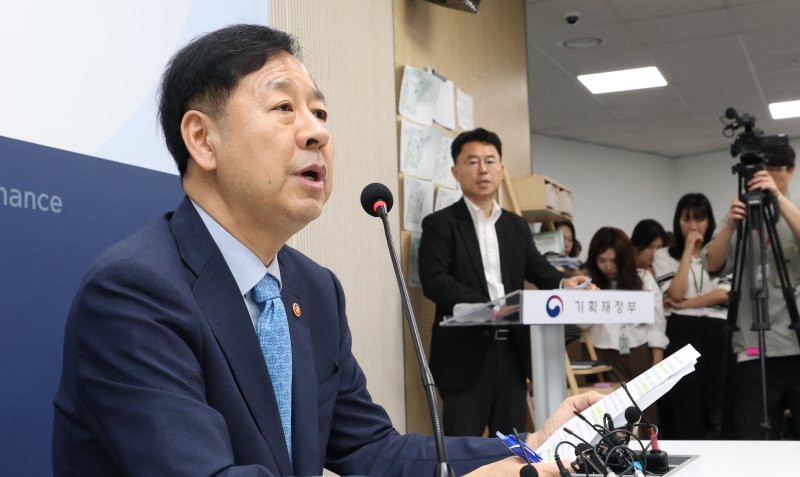
Deputy Prime Minister and Minister of Economy and Finance Ku Yoon-cheol expressed that there are no issues regarding the Ministry of Strategy and Finance being split for the first time in 18 years. In response to concerns that economic policy coordination capabilities might weaken, he dismissed them by saying, "I don't see it that way." Regarding criticisms of increasing national debt, he emphasized that a virtuous cycle structure that grows the economy through fiscal expansion is more necessary at this point. He also announced the launch of a task force (TF) to address mandatory spending for long-term fiscal soundness.
“No Issues with Policy Coordination in the Split of the Ministry of Strategy and Finance”
Deputy Prime Minister Ku said at a press conference held at the press room of the Ministry of Strategy and Finance in the Government Complex Sejong on the 8th, "Just because the Ministry of Strategy and Finance and the Budget Office, which have been like a family, are splitting up, it doesn't mean they are no longer family," adding, "When they are apart, new advantages may emerge." He continued, "I have been coordinating policies for a long time and understand the logic of budgeting, so I will coordinate well so there are no concerns."
The ruling party, government, and presidential office announced a government reorganization plan to split the Ministry of Strategy and Finance into the Ministry of Economy and Finance and the Planning and Budget Office starting January next year. This means the Ministry of Strategy and Finance will be split again for the first time in 18 years since its integration in 2008.
The Ministry of Economy and Finance will handle economic policies and taxation, while the Budget Office will be established under the Prime Minister's Office to take charge of budget tasks. The domestic financial policy tasks currently handled by the Financial Services Commission will also be moved to the Ministry of Economy and Finance.
Deputy Prime Minister Ku explained, "Even if finance is currently separate, there is no problem as we can communicate sufficiently through the financial consultative body. According to the government reorganization plan, finance will come in and fiscal will go out, and the Ministry of Strategy and Finance cannot hold everything at once."
Materializing the Ultra-Innovative Economy Leading Project
Deputy Prime Minister Ku plans to accelerate policy implementation as he has successively announced 30 leading projects within the new government's economic growth strategy, the 2026 budget proposal, and the 3rd long-term fiscal outlook (2025-2065).
While the Ministry of Strategy and Finance focuses on macroeconomic management, it plans to materialize ultra-innovative economy leading projects such as achieving a 20% self-reliance rate in silicon carbide (SiC) power semiconductor technology from a micro-targeting perspective in the long term. Deputy Prime Minister Ku used the term "micro-targeting" in terms of achieving "precise goals."
Deputy Prime Minister Ku said, "Macro management alone does not yield results. Therefore, we will harmonize the two by micro-targeting," and "The 15 leading projects of the ultra-innovative economy will be discussed at the Industrial Competitiveness Enhancement Ministers' Meeting on the 10th, where the ministers of the responsible departments will prepare the implementation plans." He also said, "In September, we will visit companies, and hold a task force meeting supported by the responsible departments, related organizations, experts, universities, and the Ministry of Strategy and Finance to prepare a roadmap for each project by the end of October. Once the budget is allocated from November, we will launch a speed battle to execute immediately from January next year."
Launch of Fiscal Structure Innovation TF
Conscious of criticisms regarding national debt, the Ministry of Strategy and Finance's second vice minister, who is the team leader, announced plans to launch a "Fiscal Structure Innovation TF" to prepare a roadmap within the year for stabilizing social insurance finances, improving the preliminary feasibility and private investment systems.
He also argued that rather than tightening budget spending, a virtuous cycle structure that grows the economy through expansionary fiscal policy, thereby increasing GDP and reducing debt, is needed at this point. He emphasized the need for bold fiscal management in the global AI competition.
The government previously projected on the 3rd that by 2065, South Korea's national debt would soar to a maximum of 173.4% of GDP. This means that the national debt ratio to GDP, which is currently at 49.1%, will more than triple over 40 years.
Deputy Prime Minister Ku said, "We have done a lot of (restructuring) of discretionary spending, but we will look for more to do with mandatory spending," indicating that it is a long-term task as many aspects of mandatory spending require significant social consensus. He added, "If we lower the growth rate to maintain fiscal soundness now, all the increased money will go to mandatory spending, and discretionary spending to develop the country will become negative," and "We will aim for a 4% deficit in the managed fiscal balance and use the resources to achieve results in productive areas. Even if only 2 out of the 20 sure items among the 30 ultra-innovative economy items succeed, South Korea can change."
Meanwhile, Deputy Prime Minister Ku was cautious about real estate taxation.
Deputy Prime Minister Ku said, "If possible, I will cautiously push for using taxation in the real estate market," and "We will review it if necessary, considering the real estate situation and the principle of ability-to-pay (taxation according to the taxpayer's ability to pay)." He added, "We need to watch more the effects of the June 27 demand measures and the supply measures announced on the 8th."
junjun@fnnews.com Choi Yong-jun, Lee Bo-mi reporters