Red Moon Pours Down at Dawn... The Whole Country's Night Sky Stirs with the First Total Lunar Eclipse in 3 Years
- Input
- 2025-09-08 07:09:40
- Updated
- 2025-09-08 07:09:40
Citizens Flock to Telescopes to Observe Saturn and Nebulae
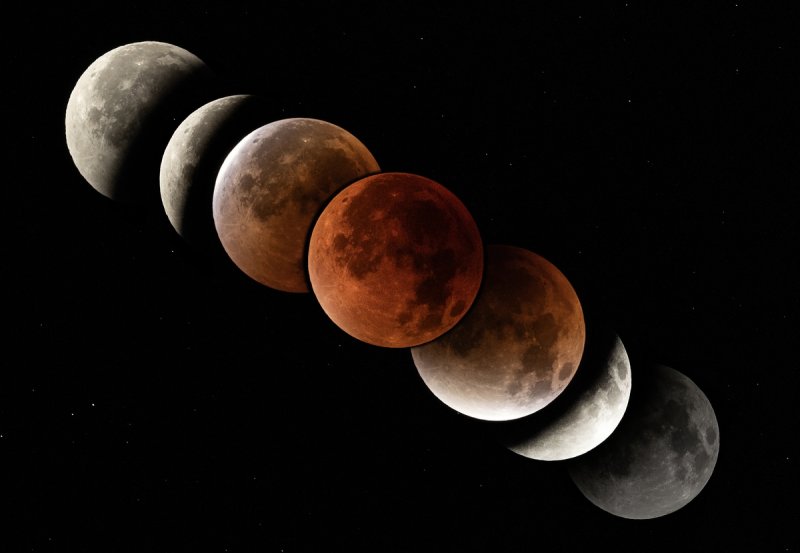
[Financial News] The sky turned red as the total lunar eclipse reached its peak. Citizens gathered at science centers and observatories across the country to witness the 'Blood Moon' that appeared for the first time in 3 years, and cheers echoed through the long night.
According to the Korea Astronomy and Space Science Institute and local observatories, this total lunar eclipse began at 2:30 AM and reached its peak at 3:11 AM, concluding around 5:56 AM. As the Earth's shadow completely covered the moon, it appeared blood-red, rising as a giant sphere in the sky.
At Bohyeonsan Astronomical Science Museum in Yeongcheon, Gyeongbuk, a special lecture was held alongside observations through large telescopes set up outdoors, allowing people to view not only the red moon but also Saturn, nebulae, and star clusters. Families and astronomy enthusiasts gathered at the event, shoulder to shoulder, gazing at the sky. The Center of Korea Observatory in Yanggu, Gangwon, and the Nuri Observatory at Daeya Library in Gunpo also held observation events for citizens, while in parks and urban areas of Daejeon and Seoul, citizens pointed their smartphone telephoto lenses and binoculars at the night sky.
Many captured the red moon with their cameras, exclaiming, "This is a scene you won't easily see again." In fact, this total lunar eclipse is the first full process eclipse since November 2022. Experts explained that while it can be observed with the naked eye, using a telescope allows one to experience the texture of the moon's surface and changes in light more vividly.
A total lunar eclipse occurs when the Sun, Earth, and Moon align, causing the Earth's shadow to completely cover the moon. The red color is due to atmospheric scattering. The 'Blood Moon' was clearly visible nationwide, and in some areas, it unfolded like a panorama alongside constellations.
The next full process total lunar eclipse is scheduled for January 1, 2029.
[email protected] Jeong Ji-woo Reporter