[fn Editorial] The Active Role of a Bridge Between Labor and Management Expected from President Lee
- Input
- 2025-09-04 18:54:28
- Updated
- 2025-09-04 18:54:28
Korean Federation of Trade Unions, Luncheon with Chairmen of Korean Confederation of Trade Unions
Efforts to Minimize Side Effects of 'Yellow Envelope Act'
Efforts to Minimize Side Effects of 'Yellow Envelope Act'
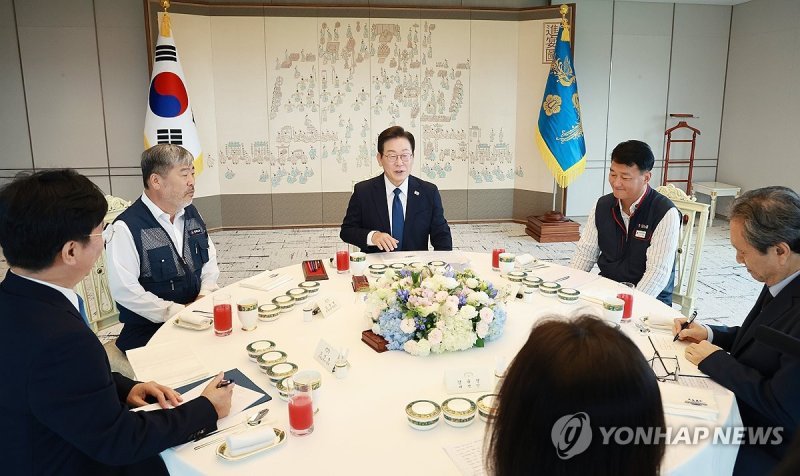
The most important labor issue currently is the Yellow Envelope Act. It seems there was no direct dialogue regarding this law. Although it is set to be implemented in about 5 months, several side effects have already appeared. The strike movements of large company unions are more intense than ever, and protests by subcontractor unions are continuing. It is said that the headquarters of General Motors (GM) in the United States canceled the small electric vehicle project they had been preparing in Korea, likely influenced by the implementation of the Yellow Envelope Act.
Of course, President Lee cannot deny that he is trying to maintain a neutral stance between labor and management, as he stated. President Lee also remarked in a cabinet meeting, "Both companies and labor are important. We must not make the mistake of killing the cow while trying to catch the bull's horn." Although it is unclear what is the bull's horn and what is the cow, it can be understood as meaning that the side effects of the bill should not harm the entire economy.
Since the bill has already passed, the government must persuade and demand that unions refrain from excessive or extreme actions as much as they seek the understanding of entrepreneurs. President Lee should also take the lead in such a role. President Lee's visit to a small and medium-sized enterprise in Ansan, Gyeonggi, where he said, "(If companies or unions) are violent or too selfish, it is a problem," is also seen as part of this effort.
If, as companies fear, strikes by subcontractor unions become routine after the implementation of the Yellow Envelope Act, it could cause significant management issues. The increased financial burden is secondary, but production and development activities could be disrupted due to negotiations with numerous unions. Deliveries may be delayed, and the shipment of products from primary companies may be delayed or halted. This will negatively impact the overall economy.
Considering the demands of subcontractor unions and the entire economy, the former is obviously the bull's horn, and the latter is the cow. Even if the Yellow Envelope Act has good intentions and purposes to improve the rights of labor's weak, the economy must thrive for companies and unions to exist. If companies die and the economy collapses, how can unions exist? Therefore, it is concerning what will happen after this law is implemented.
Even responding to legal collective bargaining and collective action is not an easy task. The manpower to negotiate with unions is an issue, as is time. In this situation, what the government can do is persuade unions to minimize the side effects of the law. They must request restraint in excessive labor actions and create guidelines. Illegal strikes must, of course, be strictly dealt with using public authority. In the future, the government should actively arrange dialogues between labor and government, and between labor, management, and government, so that President Lee and the government can listen to the difficulties of companies and act as a bridge.