Choi Tae-won: "Economic Growth Depends on Lifting Differential Regulations by Company Size"
- Input
- 2025-09-04 18:32:58
- Updated
- 2025-09-04 18:32:58
At the Launch of the Corporate Growth Forum, a Determined Statement
"Current Commercial Law Has a 2 Trillion Won Asset Hurdle
Some Medium Enterprises Stay to Avoid Regulatory Nets"
Request for Exceptional Application in Advanced Industry Fields
"Current Commercial Law Has a 2 Trillion Won Asset Hurdle
Some Medium Enterprises Stay to Avoid Regulatory Nets"
Request for Exceptional Application in Advanced Industry Fields
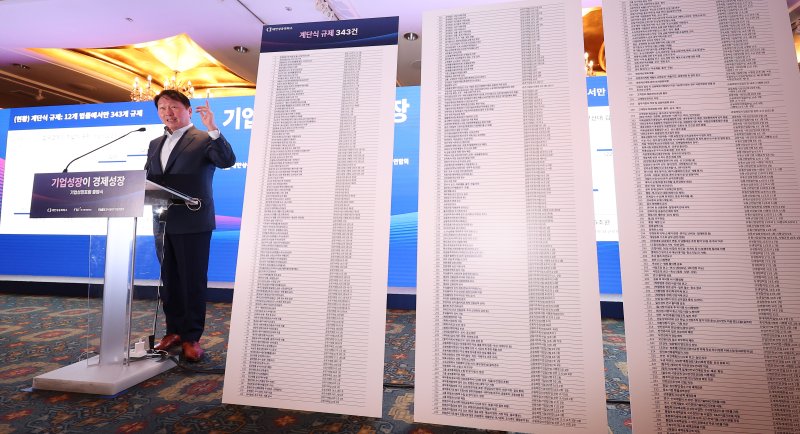
Chairman Choi reiterated in his keynote speech at the 'Corporate Growth Forum Launch' jointly hosted by the Korea Chamber of Commerce and Industry, the Korea Economic Association, and the Korea Federation of Medium Enterprises at the Lotte Hotel in Jung-gu, Seoul, that "the wall of regulations must be removed for growth momentum to continue." Chairman Choi said, "As long as regulations exist, it is sometimes thought that staying as a small enterprise is advantageous, and companies do not intentionally increase their size by splitting up." He pointed out, "There is a '2 trillion won hurdle' under the current commercial law," adding, "A company with assets of 1.9 trillion won will absolutely not try to increase its assets further to avoid the regulatory net."
According to the 'Differential Regulation Survey' results announced by the Korea Chamber of Commerce and Industry and Professor Kim Young-joo's research team from Busan National University, there are 343 differential regulations by company in 12 economic-related bills, and a whopping 6,000 economic penalty-related clauses. Chairman Choi said, "The stepwise regulations in the Korean economy are a fundamental reason for the stagnation of Korea's growth, particularly reducing the vitality of the private sector," and added, "(These stepwise regulations) were correct in the past, but they are wrong now." He requested an evaluation of the industrial impact of stepwise regulations and the application of exceptions to advanced industry fields in enforcement decrees and rules.
On this day, major domestic companies targeted the 'large company strangulation' regulatory policy, raising their voices, saying, "In the U.S. or Europe, regulations are not operated with such standards." Park Seung-hee, head of Samsung Electronics' CR division, emphasized in a closed meeting held on the same day, "As large companies like Samsung compete globally overseas, support measures that do not consider size are now needed." In fact, 82% of Samsung Electronics' sales of 301 trillion won last year were generated overseas. Park said, "So far, most large company regulations have been formed from a national perspective (public opinion standard)," and pointed out, "These regulations were created in a dichotomous relationship between large companies and small enterprises, and large companies and workers, but global tech companies in the U.S. or Europe do not operate regulations with such standards."
Lee Hyung-hee, Chairman of the SK Supex Council (President), also suggested regulatory improvements, saying, "It is necessary to align with global standards so that business activities can be predictable." Deputy Prime Minister and Minister of Strategy and Finance Koo Yoon-cheol, who attended the event, responded, "Since both small and large enterprises are in an emergency situation, the government plans to mobilize all capabilities to support companies to win in fierce global competition."
ehcho@fnnews.com Cho Eun-hyo, Kwon Jun-ho, Park Moon-soo reporters