Seoul Central District Court, 'Efficient Judgment Writing' Seminar
- Input
- 2025-09-04 14:05:50
- Updated
- 2025-09-04 14:05:50
Sharing Achievements of the Court Implementing Judgment Optimization... Focusing on Rapid Trial
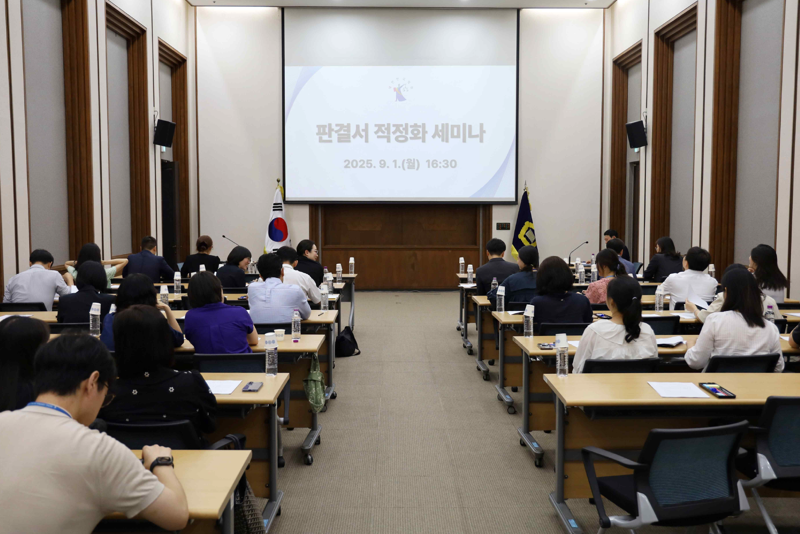
[Financial News] The Seoul Central District Court has arranged a discussion to find ways to reduce the excessive time spent on writing judgments to ensure thorough trials.
The Seoul Central District Court announced on the 4th that it held a 'Judgment Optimization Seminar' on the 1st and shared the progress and achievements of the court implementing judgment optimization.
The Central District Court has been operating a court implementing judgment optimization since May last year to prevent the excessive time spent on writing judgments and to focus on rapid trials.
Judgment optimization is a policy that reduces the burden of writing judgments so that excessive time is not spent in the process of writing judgments, which is part of a judge's duties. At the same time, it ensures that the judgment is written in a way that thoroughly answers the questions of the parties involved in the lawsuit. This initiative was promoted considering the deepening issue of trial delays and the difficulty for litigants to understand the judgments. Additionally, it aims to appropriately distribute judicial resources and trial capabilities, considering the changing composition of the court's personnel, such as the unification of the legal profession and the establishment of a lifelong judge system.
At the seminar, Judge Park Chang-woo of the 207th Civil Division of the Central District Court gave a presentation on the specific content of judgment optimization and future improvement directions. Attendees, including Chief Judge Jo Yong-gi of the 49th Civil Division, shared experiences and exemplary cases of the court's contribution to simplifying judgments and reducing the burden of writing them.
The attendees emphasized that a judgment is not merely a document stating the conclusion of a trial, but also serves as an 'answer function' explaining the reasons for the judgment to the parties involved, and simultaneously acts as a 'legal foundation' defining the scope of enforcement and res judicata.
A representative of the Central District Court stated, "(The judges participating in the seminar) agreed on the need to actively attempt judgment optimization within the framework of relevant laws to achieve both the thoroughness of arguments and the optimization of judgment writing," and added, "We will continue to devise effective systems to appropriately distribute the diverse experiences and capabilities of judges."
[email protected] Choi Eun-sol Reporter
[email protected] Choi Eun-sol Reporter