[fn Editorial] North Korea-China-Russia Leaders Demonstrate Cohesion, Urgent Need for South Korea-U.S.-Japan Security Cooperation
- Input
- 2025-09-03 18:54:41
- Updated
- 2025-09-03 18:54:41
Three-Nation Summit Reenacted After 66 Years
Practical Diplomacy Key Amid Bloc Confrontation
Practical Diplomacy Key Amid Bloc Confrontation
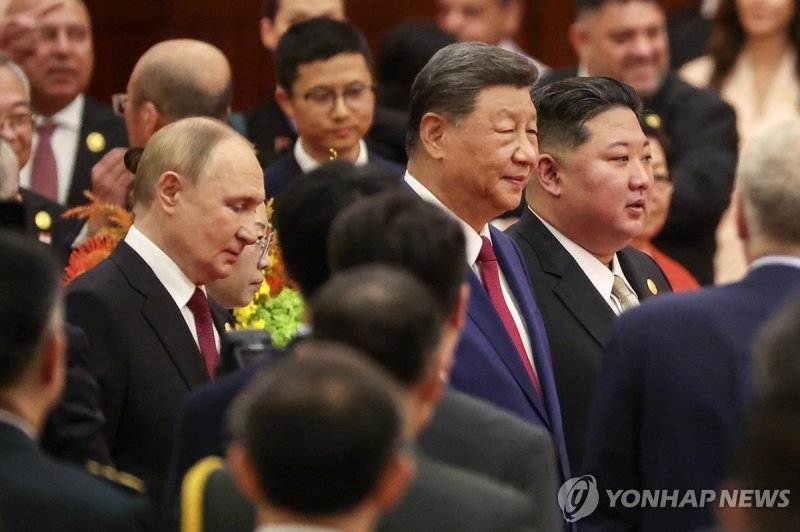
On the occasion of the Chinese Victory Day event, China expressed its intention to stand at the center of the international order. It has embraced North Korea and Russia, which are under U.S. checks and pressures, claiming the role of the pivot of the 'anti-Western alliance'.
Even though it is the era of Donald Trump, President of the United States, who leads with tariff cards, it can be seen that China has expressed its intention to stand as a counterpoint to the United States.
Prior to the Victory Day event, the Shanghai Cooperation Organization (SCO) summit, attended by 26 countries including China, Russia, and India, announced the 'Tianjin Declaration' targeting U.S. unilateralism. China seems to be strengthening its security alliance by providing financial support to SCO member countries.
As North Korea, China, and Russia demonstrated solidarity on the occasion of the Chinese Victory Day, it is believed that South Korea's practical diplomatic line has also been put to a new test. If the new Cold War-like structure of 'South Korea-U.S.-Japan vs. North Korea-China-Russia' is strengthened, South Korea's balanced diplomacy will inevitably be constrained. China and Russia are important economic partners for South Korea and key parties in resolving the North Korean nuclear issue. However, as the North Korea-China-Russia alliance strengthens, there is a great concern that bloc logic will operate strongly.
There are signs that significant changes are coming in inter-Korean relations. Chairman Kim Jong-un made his first appearance on the multilateral diplomatic stage through this Victory Day. North Korea has so far relied only on bilateral talks. However, by attending the Victory Day event, it seems that North Korean diplomacy is expanding to the multilateral stage, aiming to enhance its external negotiating power. The 'Anrokyungjung' strategy, which means security with Russia and economy with China, seems to be being formalized as a two-track diplomacy. Recently, North Korea has focused on Russia due to the Ukraine war, but by restoring relations with China, it has broadened its negotiating power and options. This suggests that when discussing the Korean Peninsula issue in the future, North Korea's voice and negotiating power could also increase.
As the North Korea-China-Russia axis solidifies, South Korea's practical diplomatic line will face complex challenges. It is possible to find a balance point of selective cooperation and checks with China and Russia. However, during a time of intensified bloc confrontation, a dual approach is needed to respond firmly to security threats.
In fact, due to the aftermath of the tariff war triggered by the United States, the cohesion among allies centered on the United States is not what it used to be. Amidst the weakening solidarity among global democratic blocs, China's move to lead a new international order became visible at this Chinese Victory Day event. As such international geopolitical dynamics rapidly change, our government must demonstrate wise diplomatic capabilities. It is necessary to prepare for the possibility of ideological geography becoming entrenched due to the strengthening of the North Korea-China-Russia alliance.
Therefore, it is important for President Lee Jae-myung to express our government's firm commitment to North Korean denuclearization at the United Nations General Assembly in New York on the 23rd. Furthermore, to reduce security risks in Northeast Asia, the institutionalization level of South Korea-U.S.-Japan cooperation should be further enhanced to strengthen the alliance against the North Korea-China-Russia bloc.