[fn Editorial] 'Nobong Law' Boosts General Strike, Urgent Measures Needed to Prevent Chaos
- Input
- 2025-09-03 18:54:38
- Updated
- 2025-09-03 18:54:38
Opposition to Merger, Excessive Demands for Retirement Extension
Adjustment of Strike Rights, Early Rectification of Legal Loopholes
Adjustment of Strike Rights, Early Rectification of Legal Loopholes
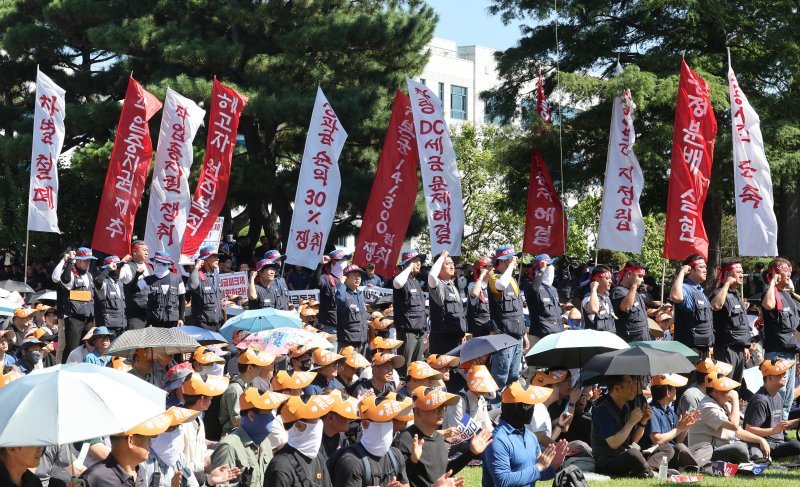
The simultaneous strike declaration by unions at a time when companies are at a critical juncture due to the U.S. tariff bomb is a major threat to the Korean economy. The Hyundai Motor Union is demanding a basic salary increase, a 30% bonus of last year's net profit, retirement extension without income reduction, and a 4.5-day workweek. However, Hyundai Motor is in an emergency due to the U.S. tariff storm affecting its performance. Since April, the 25% tariff imposed by the U.S. caused the operating profit in the second quarter to fall by 16% compared to the same period last year. The tough journey intertwined with the electric vehicle chasm (temporary slowdown) is inevitable. Although it is a time when labor-management coexistence is more necessary than ever, the union is pressuring the management by demanding retirement extension and a 4.5-day workweek, which the company cannot resolve on its own, leaving one speechless.
Retirement extension is a strongly pushed agenda not only by Hyundai Motor but also by the Hyundai Heavy Industries unions and the financial sector unions, which are scheduled to strike at the end of this month. The Financial Industry Union, which includes commercial banks and the Industrial Bank of Korea, declared on the 2nd that it would go on a general strike from the 26th, demanding a 5% wage increase along with retirement extension and full implementation of a 4.5-day workweek. It is also difficult to gain public sympathy for striking for the welfare of employees who receive high salaries in companies making record profits through high-interest rate businesses.
The union's announcement of a series of strikes is not unrelated to the influence of the Nobong Law, which expanded the scope of union disputes and strongly empowered unions. The Nobong Law encompasses the scope of union disputes to include corporate restructuring and business consolidation. Many analyses suggest that the Hyundai Heavy Industries union's strike against the merger of affiliates was prompted by related provisions of the Nobong Law. Despite damages caused by illegal strikes, the right of companies to claim compensation is extremely limited, rendering it meaningless. With enhanced labor rights, indiscriminate strikes may become more rampant in the future.
The government and the ruling party tried to downplay corporate concerns related to the Nobong Law as exaggerated, but the reality is different. The law is set to be implemented in six months, but the chaos already sweeping the field should not be taken lightly. The national economy and corporate management are precarious during this global industrial upheaval. The playing field, heavily tilted towards the unions, must be corrected. From now on, the loopholes in the law should be addressed by reflecting the concerns of the field.