'SPA Bought for Cheap' Becomes a Blue Chip in Fashion with 'Value for Money + Value'
- Input
- 2025-09-03 18:00:27
- Updated
- 2025-09-03 18:00:27
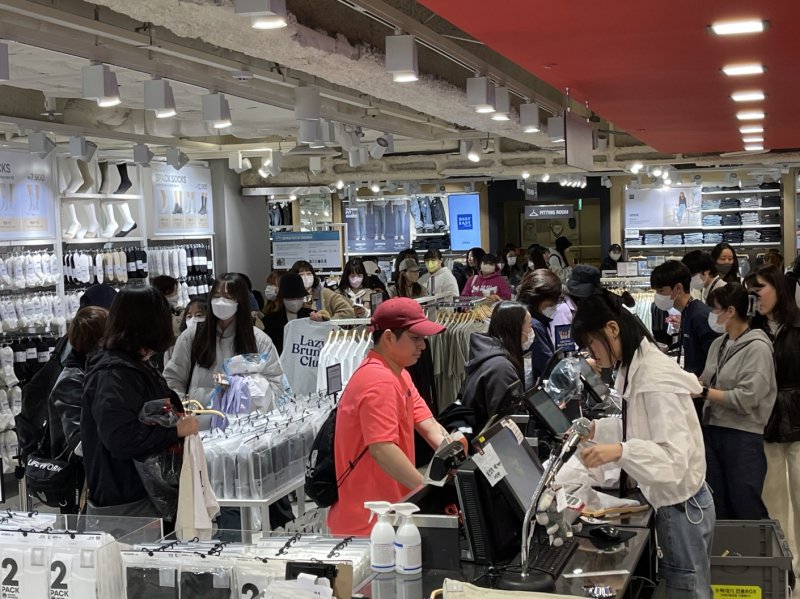
[Financial News] As the fashion industry experiences a recession due to the economic downturn and high inflation, the presence of SPA (Specialty store retailer of Private label Apparel) brands, which continue to grow, is increasing. It is analyzed that SPA, which used to rely on low prices and large-scale store openings, is evolving by adding value for money and quality and brand value during the economic downturn.
Cost-effectiveness during recession is effective
According to the fashion industry on the 3rd, SPA brands are expanding their market position based on rational consumer psychology and agile production and distribution structures, even as consumption is shrinking due to the global economic downturn. Uniqlo recorded sales of 1.0601 trillion won in Korea for the 2024 fiscal year, returning to the '1 trillion won club' for the first time in six years since the 2019 boycott. E-Land Spao's sales grew by more than 50% from 400 billion won in 2022 to 600 billion won in 2024, and Shinseong Tongsang's Top Ten also achieved sales of 970 billion won last year and is on the verge of breaking through 1 trillion won in sales this year.
Recently, the growth of SPA is primarily attributed to changes in consumer psychology in the era of high inflation. As living expenses increase, consumers are clearly focusing on basic items that can be worn for a long time or products with proven quality, instead of reducing clothing expenses. An industry official analyzed, "The trend of 'wise consumption,' which considers not only cheap clothes but also quality, design, and brand trust relative to price, has taken root."
SPA's fast production and distribution structure is also boosting purchasing power. The short time from planning to product display increases trend responsiveness, allowing new products to be launched quickly even during a recession. However, speed competition alone entails inventory burden, price reduction competition, and trend fluctuation risks. An industry official said, "The essence of the SPA industry is fast planning and production, but that alone cannot guarantee long-term growth," adding, "Strengthening brand value and product competitiveness is an essential task."
Brand and product strength enhancement is the key
In this context, SPA brands are shifting from simple store opening competition to a 'selection and concentration' strategy. A representative example is Uniqlo. Although sales plummeted due to the 2019 boycott, it rebounded with the 'LifeWear' philosophy and efficient store operations, surpassing 1 trillion won in domestic sales again last year. Recently, it has been strengthening its strategy by reducing inefficient stores and focusing on large and key stores. The Dongseongro store, the largest in Daegu and Gyeongbuk, and Jeju's first roadside store are representative. At the same time, it is enhancing its brand image by expanding collaboration lineups with global designers, adding design and value to basic items.
Domestic SPA brands are also focusing on strengthening product power rather than expanding stores. Shinseong Tongsang's Top Ten has shifted from the '19,000 won and 25,000 won' price strategy to a method that adds quality and brand value on top of reasonable prices. It is building brand identity by strengthening its own content instead of big models and emphasizing sustainability to shed the image of 'cheap clothes.'
Spao is enhancing its competitiveness based on research and development (R&D) and group infrastructure. The Fashion Research Institute Archive plays a role in identifying trends at the planning stage, and the '2-day and 5-day production system' (2 days for small samples, 5 days for mass production) quickly commercializes market responses to reduce inventory burden. This system has become the foundation for the success of basic items like wrinkle-free shirts and denim, as well as trendy products like collaboration pajamas.
An industry official said, "SPA can no longer survive solely on low prices and store opening competition," adding, "As consumers consider value relative to price, brand philosophy and sustainability will be the key."
clean@fnnews.com Lee Jeong-hwa Reporter