[fn Editorial] Despite Tariff Shock, Exports Thrive, Path Found in New Market Development
- Input
- 2025-09-01 18:52:04
- Updated
- 2025-09-01 18:52:04
Thanks to market diversification in Europe, Middle East, etc.
Need to hasten preparations for full impact of tariffs
Need to hasten preparations for full impact of tariffs
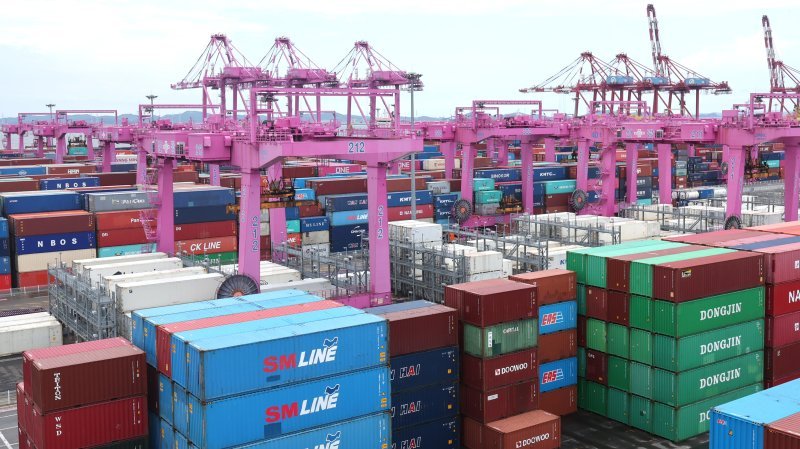
Despite such success, it is difficult to say that the export front has turned green. Significant changes are being detected in the external export environment. First, exports to the U.S. decreased by 12% to 8.74 billion dollars, recording the lowest level in two and a half years. Although it was an expected result, the shock has become a reality. Even exports to China, our largest trading partner, decreased by 2.9%. Our country's exports have simultaneously retreated in the U.S. and Chinese markets, the two main pillars of Korean exports. As exports to China deteriorate, the focus is shifting to the U.S. However, as the U.S. tariff barrier rises, exports in August decreased by double digits. We must compensate for the decrease in the two major export countries with other countries.
The impact of U.S. reciprocal tariffs has not yet fully manifested. It is expected to take at least a month or two for it to be fully reflected in the market. Currently, we are seeing the effect of pre-demand in preparation for tariff imposition. Nevertheless, exports to the U.S. in August decreased significantly. If the tariff impact becomes full-fledged in a few months, export volumes may decrease further. Companies and the government should focus on upgrading export capabilities while preparing measures to maintain exports to the U.S.
The government should quickly prepare support measures for the impact of U.S. tariffs on our companies. It is a natural measure that Minister Kim Jeong-gwan of the Ministry of Industry announced that he would announce measures to minimize the damage to our companies from the U.S. tariff measures early this month. The problem is the effectiveness of the measures. We hope to see a comprehensive export strategy, from financial support to cushion the tariff shock, marketing support for exploring alternative markets, to plans to help companies reorganize their supply chains.
The strong export performance in August is a clear result of the effects of export market diversification. Efforts to diversify markets should continue in the future. We must win the market preemption competition with competing countries like Japan, which are in a similar situation to us. The indomitable will to navigate the five oceans and six continents, including Africa, is more important than ever. To survive in fierce competition, constant innovation in products and services is essential.
It is also a task to solve the concentration of exports in specific industries and items through diversification. In the current situation where semiconductors account for a quarter of total exports, if the semiconductor market deteriorates, the entire Korean economy will be shaken. We must simultaneously promote the strengthening of competitiveness in new growth industries such as bio, health, and secondary batteries, along with the high value-added of existing key industries.
The export performance in August is a testament to the resilience of Korean exports. However, we must keep in mind that a tariff storm from the U.S. is expected to hit the global export market in the second half of the year. It is time for the government and companies to make every effort to cope with the increasingly uncertain market environment.