[fn Editorial] Even Public Institutions in Debt Expand Finances, Start with Painful Self-Help Measures
- Input
- 2025-09-01 18:52:01
- Updated
- 2025-09-01 18:52:01
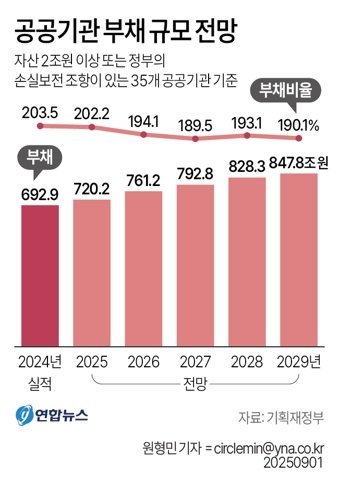
Debt Expected to Rise to 848 Trillion Won in 5 Years
Organize Underperforming, Redundant, and Low-Performance Projects
Organize Underperforming, Redundant, and Low-Performance Projects
It is necessary for public institutions to take the lead in growth and people's livelihoods. Public institutions have no choice but to align with the government's policy of using finances as a pump primer for economic recovery. A significant portion of public institution debt is due to investments in expanding social overhead capital (SOC) such as housing and roads. Examples include Korea Electric Power Corporation's energy highway construction, power companies' renewable energy investments, and Korea Land and Housing Corporation (LH)'s housing purchase rental business.
The issue is the feasibility of resources to support large-scale investments. If public institutions had voluntarily reduced internal populist welfare and established solid management through bold restructuring, there would be little concern. However, they have been criticized for high salaries and lax management while sitting on a pile of debt. Repeated parachute appointments and resistance from strong unions have slowed down reforms. In this situation, taking on more debt to follow the government's expansionary fiscal policy raises concerns about management burdens.
Of course, there are some public enterprises whose financial structures have somewhat improved, but this is largely due to the impact of falling oil prices and rate hikes rather than the results of internal reforms. In fact, Korea Electric Power Corporation's debt ratio soared to 543% during the international oil price surge in 2023, but fell below 500% thanks to efforts to normalize rates last year. In this context, the government expects the debt ratio relative to assets of 35 public institutions to slow from 202% this year to 190% in 2029. However, the debt size of 848 trillion won, which increases by 128 trillion won in five years, cannot be considered small. It is believed that public institutions should transform their constitution with painful self-help measures and then boldly invest based on this.
According to the recently announced budget plan for next year, the national debt will increase by 113 trillion won from this year to 1,415 trillion won. This is the first time it exceeds 50% of the gross domestic product (GDP). Five years later, the national debt will swell to 1,788 trillion won. There is a need for awareness of the reality that the entire country, including households, businesses, the government, and public institutions, cannot escape from the mire of debt.
The government has announced plans to accompany public institutions' self-help efforts, but a firm commitment and a new, concrete reform roadmap must be established. Investment priorities should be fully adjusted considering business demand, and underperforming, redundant, and low-performance projects should be organized. Expenditure restructuring should be boldly and swiftly promoted regardless of the field. The same goes for the rapidly increasing government fiscal mandatory expenditures. The proportion of mandatory expenditures in the total budget will rise from 51.9% this year to 55.8% in 2029. There are numerous areas in need of surgery, such as education grants, which result in large-scale unused budgets every year. Bold structural improvements must begin in all public sectors.