[Exclusive] "Just one puff of liquid marijuana can mess you up" Why he targeted college campuses
- Input
- 2025-09-01 16:22:51
- Updated
- 2025-09-01 16:22:51
Risk of drug exposure to young people in their 20s through flyers on college campuses
New types of drugs, possibility of distribution disguised as legal products
Experts "Need for preventive education and harsher penalties"
New types of drugs, possibility of distribution disguised as legal products
Experts "Need for preventive education and harsher penalties"
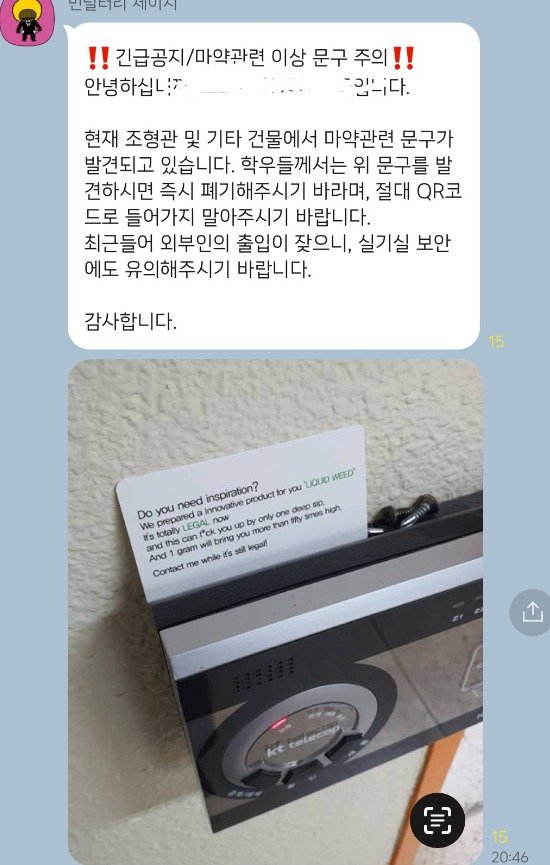
[Financial News] "Need inspiration? We have prepared an innovative product 'liquid marijuana' for you. It is currently completely legal, and just one puff can completely mess you up."
In October 2023, 11 flyers selling liquid marijuana were found on the windshield of a car parked in front of the Art and Design College parking lot at Konkuk University. These flyers were also found in the lockers of the sculpture department at Hongik University and the practice rooms and locker handles at the College of Arts at Gachon University, revealing a total of 190 flyers were distributed.
The text on the business card-sized flyers was all written in English. On the back, a Telegram QR code was printed, blatantly intending to connect buyers in a secretive manner.
According to Financial News' comprehensive investigation on the 1st, the person who distributed the flyers is Mr. Kim (42), who has a history of drug trafficking. He was eventually caught by the police and brought to trial for violating the Narcotics Control Act, and the 12th Criminal Division of the Seoul Eastern District Court (Chief Judge Lee Jeong-hyeong) sentenced him to 1 year in prison and 3 years of probation.
Mr. Kim's side argued that the hexahydrocannabinol (HHC) liquid he intended to sell was not subject to legal punishment, but the court thought otherwise. The court judged that the advertising act itself promoted the sale of liquid marijuana, raising concerns about inducing misuse.
However, the court took into account that the advertisement included the phrase 'this product is still legal', and that actual inquiries were few, resulting in a suspended sentence. Considering that HHC liquid was not regulated at the time of the crime, the charges of purchasing, receiving, and possessing liquid marijuana were found not guilty. Mr. Lee (31), an office worker who conspired with Mr. Kim, was also acquitted.
However, experts warned that this should not be dismissed as just another common drug case. It is a representative case showing how easily college campuses can be exposed to drugs, as new types of drugs penetrate regulatory blind spots. Experts interpreted the concentration of flyers on college campuses as a strategy targeting the curiosity and openness of people in their 20s.
Professor Yoon Heung-hee of the Global Addiction Rehabilitation Counseling Department at Namseoul University Graduate School said, "Young people entering college are at a time when they enjoy freedom and autonomy after being suppressed during high school," and "Since there is virtually no preventive education on drugs, they are vulnerable to temptation, and there is a high possibility that methods such as 'drug throwing' will be discovered on campuses in the future," he expressed concern.
Lawyer Park Jin-sil, a drug specialist, also diagnosed, "Since college students frequently visit clubs and are highly exposed to drugs, it is easy for them to think 'it's okay just once' out of curiosity, and they may have been judged to be potential long-term customers."
Actual statistics also support this. According to the age-specific crackdown status in the '2024 Drug Crime White Paper' by the Supreme Prosecutors' Office, the 2030 generation accounted for the largest proportion of all drug offenders last year at 60.8%. In the National Police Agency's tally, 61.8% of all online drug offenders (1,878 people) were young people in their 10s to 30s. It is evidence of the analysis that the more familiar young people are with the internet and social networking services (SNS), the higher the accessibility to drugs.
Professor Lee Beom-jin of the College of Pharmacy at Ajou University (Director of the Drug Eradication Research Institute) pointed out, "In the case of most young drug offenders, they get involved with drugs due to peer recommendations or curiosity," and "The combination of peer culture and internet familiarity accelerates the spread."
This incident also revealed institutional loopholes. The problematic HHC was designated as a temporary drug only after the incident occurred on October 18 last year, and it was incorporated into the drug category on the 12th of last month.
As hundreds of new drugs appear every day, the speed of drug designation and management cannot keep up, creating blind spots, and in this process, there is a possibility that not only 'legal products' but also illegal drugs could be distributed, leading to criticism that just being exposed to drug-related flyers is dangerous.
Choi Jin-mook, head of the Drug Addiction Rehabilitation Center, emphasized, "It is necessary to enact a law that imposes harsher penalties on those who sell drugs to unspecified individuals, and preventive education focusing on side effects should precede."
[email protected] Reporter Kim Ye-ji