Even with a Monthly Income of 5.07 Million Won, Savings Continue... Real Consumption Declines for Two Consecutive Quarters
- Input
- 2025-08-28 12:00:00
- Updated
- 2025-08-28 12:00:00
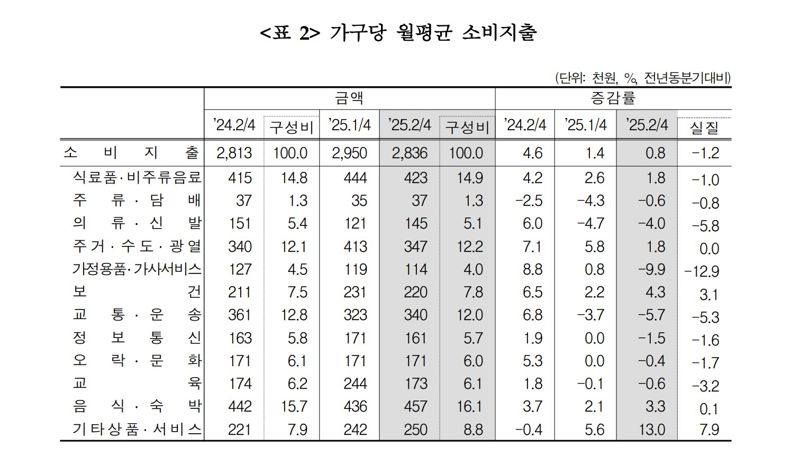
[Financial News] Following the first quarter of this year, frugal consumption continued into the second quarter. This is because real household consumption expenditure decreased. It is the first time since the 2020 pandemic that consumption expenditure, which refers to the purchase of goods and services, has decreased for two consecutive quarters.
According to the '2025 2nd and 4th Quarter Household Trend Survey Results' by Statistics Korea on the 28th, the average monthly consumption expenditure per household in the second quarter was 2.386 million won, an increase of 0.8% compared to the same period last year. Real consumption expenditure, reflecting the inflation rate, decreased by 1.2%. Real consumption expenditure has been decreasing by 0.7% since the first quarter of this year. It was the first decrease in seven quarters. The consecutive decrease for two quarters is the first since the third and fourth quarters of 2020. However, the impact of the 'Livelihood Recovery Consumption Coupon' distributed through the second supplementary budget from July was not reflected in this statistic.
In real consumption expenditure, the decrease was greatest in household goods and domestic services (-12.9%). It was followed by clothing and footwear (-5.8%), transportation and transportation (-5.3%), education (-3.2%), and entertainment and culture (-1.7%). Lee Ji-eun, head of the household income and expenditure trends division at Statistics Korea, said, "The amount spent on durable goods such as automobiles and home appliances has decreased, leading to a decrease in real consumption expenditure," and "Although the consumer sentiment index recovered in May and June, it does not seem to have been immediately reflected. During this period, domestic and international social and economic uncertainties increased."
The average monthly income per household in the second quarter was 5.065 million won, an increase of 2.1% compared to the same period last year. Meanwhile, real average monthly income remained flat. Among them, labor income was 3.194 million won, and business income was 941,000 won. In real terms, they decreased by -0.5% and -1.9% respectively compared to the same period last year. The head of the division said, "The decrease in the number of self-employed people has led to a significant decrease in business income," and "The increasing proportion of single-person households is affecting the decrease in real labor income."
Meanwhile, income increased for all households from the first to the fifth quintile in the second quarter. The average monthly income of households in the first quintile was 1.194 million won, an increase of 3.1% compared to the same period last year. Households in the fifth quintile had an income of 10.743 million won, an increase of 0.9%. In the case of the first quintile (3.1%), labor income (-7.3%) decreased, but income increased centered on business income (10.2%) and transfer income (5.7%), exceeding the overall household income growth rate (2.1%).
[email protected] Choi Yong-jun Reporter