Seoul Household Increase Surpasses Housing Supply Speed
- Input
- 2025-08-28 10:49:30
- Updated
- 2025-08-28 10:49:30
Recent 3-Year Average Annual Increase in Seoul Households: 53,000
Seoul Housing Increase: 33,000
Seoul Housing Increase: 33,000
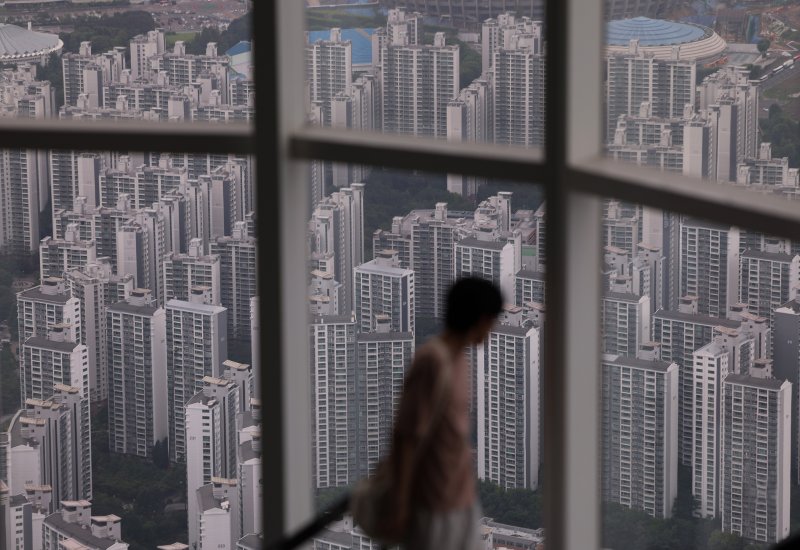
On the 28th, an analysis of the housing supply rate data released annually by Statistics Korea by Real Estate R114 showed that the rate of household increase (segmentation) in the Seoul area has surpassed the rate of housing increase (supply) for seven consecutive years. Considering that the registered population of Seoul fell below 10 million in 2016 and decreased to 9.33 million by 2024, it is interpreted that the speed of segmentation from households of 3-4 people to 1-2 people is fast.
The concept of housing ownership is based on households rather than individuals. The supply of housing in Seoul is barely enough to cope with the number of segmenting households. For example, the average annual increase in the number of households in Seoul over the past three years (2021-2023) is confirmed to be about 53,000, but the increase in the number of houses in Seoul is confirmed to be about 33,000, resulting in an excess demand of 20,000 houses per year. For this reason, it can be seen that the upward trend in house prices (especially rent and lease) in Seoul is not easily controlled even in the phase of population decline. However, if we look at a broader regional scope, the number of households nationwide increased by about 300,000 in 2023, but the number of houses increased by about 390,000, resulting in an oversupply issue in some areas such as the provinces.
Comparing the deviations between the total number of houses and households nationwide and by city/province, it is confirmed as △Seoul (-263,000 households) △Gyeonggi (-36,000 households) △Daejeon (-24,000 households) △Incheon (-11,000 households). Areas marked with a minus (-) are regions with a housing shortage. In fact, the quantitative housing indicators centered on the metropolitan area, including Seoul, are evaluated as insufficient. However, since the Statistics Korea housing supply rate aggregation criteria reflect separate residences by number of households in multi-family types, it is difficult to say that regions showing a slight plus (+) have met the quantity. Sejong City shows that the number of houses exceeds the number of households by 10,000, but considering that it is the region with the fastest population influx in the country, it is still evaluated as a region where more housing supply is needed.
Real Estate R114 stated, "In regions where the speed of household increase is faster than housing supply, such as Seoul and the metropolitan area, the demand for rent and lease, which is directly related to survival, is bound to increase continuously," and "As the government is expected to announce supply measures soon, it is hoped that customized supply expansion policies will be introduced mainly for Seoul and the metropolitan area, where the total amount of housing is insufficient."
[email protected] Jeon Min-kyung Reporter