Interest Rate Freeze Amid Concerns of Housing Price Inflation... Growth Rate Below 1% Despite Supplementary Budget [Update]
- Input
- 2025-08-28 09:52:05
- Updated
- 2025-08-28 09:52:05
Interest rate frozen at 2.50% for the second consecutive time
Pause in rate cuts due to concerns over stimulating aggressive borrowing
Growth rate improved by 0.1%p due to supplementary budget effects
Below 1% due to concerns over export slowdown such as US tariffs
Pause in rate cuts due to concerns over stimulating aggressive borrowing
Growth rate improved by 0.1%p due to supplementary budget effects
Below 1% due to concerns over export slowdown such as US tariffs
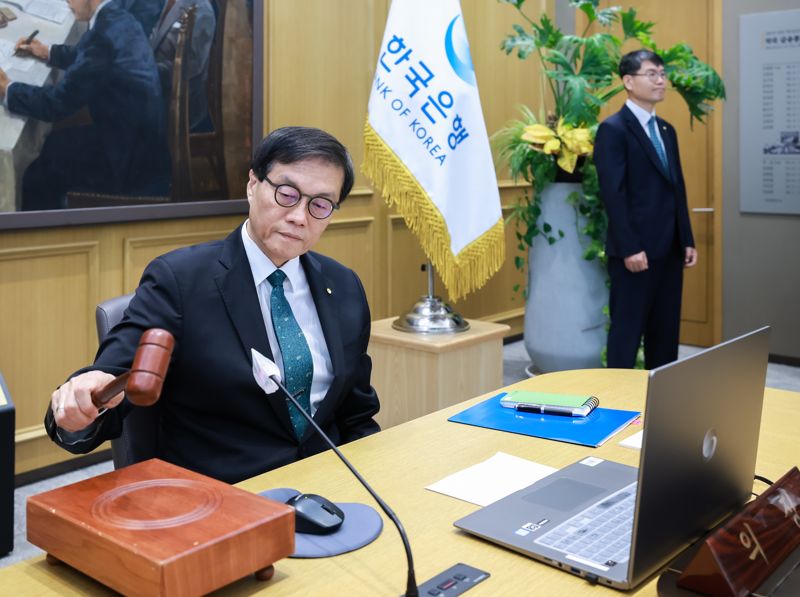
On the 28th, the Bank of Korea's Monetary Policy Committee held a meeting to decide the direction of monetary policy and maintained the base interest rate at 2.50%. As a result, the base rate, which had fallen to 2.50% in May for the first time in 2 years and 7 months since October 11, 2022 (2.50%), was frozen for the second consecutive time in July, and will remain at 2.50% until the next MPC meeting in October.
The interest rate freeze on this day aligns with market expectations. According to a survey conducted by Financial News on 10 domestic macroeconomic and bond experts <refer to our report on August 24, 2025>, all experts except one predicted that the Bank of Korea would freeze the base rate at the August MPC meeting.
The biggest factor for the Bank of Korea's consecutive rate freeze is the still unstable financial market situation, including Seoul apartment prices. Jina Kim, a researcher at Eugene Investment & Securities, said, “In the July MPC minutes, all MPC members expressed concerns about real estate prices at the time and confirmed the position that future real estate-related policies and price trends should be monitored,” adding, “This position is expected to be maintained in this meeting as well.”
In fact, Governor Lee Chang-yong of the Bank of Korea appeared before the National Assembly's Planning and Finance Committee on the 19th and warned, "Although the housing market in the metropolitan area and the growth of household debt, which showed signs of overheating, have somewhat calmed after the 'June 27 Measures', the high housing price increase trend in some areas of Seoul continues, so it is necessary to watch for trend stability." Although a rate cut is ultimately needed to defend the growth rate, more monitoring is required until confidence in financial stability is gained.
Considering the recent rise in the won-dollar exchange rate, the widening interest rate gap with the US is also evaluated as an obstacle to rate cuts. If the Bank of Korea had lowered the rate before the US Federal Reserve (Fed) at this MPC meeting, the interest rate gap, which is at a record high of 2.00%p, could have widened to 2.25%p, increasing the risk of a rise in the won-dollar exchange rate and foreign capital outflow.
The Bank of Korea's revised economic growth forecast for this year is presented at 0.9%. Thanks to the economic stimulus effect of the government's expansionary fiscal policy, it was revised up by 0.1%p from the previous 0.8%, higher than the 0.8% suggested by the Korea Development Institute (KDI) and the same as the Ministry of Economy and Finance's 0.9%. However, it falls short of the average forecast of 1.0% by eight major investment banks (IB) as of the end of last month.
In particular, there is an interpretation that the repeated sluggishness in construction investment has hindered raising the growth rate to 1%. Woonyoo Seung, a researcher at SK Securities, said, “In the second quarter of this year, construction investment recorded a contribution rate of -1.9% to economic growth,” adding, “The negative contribution rate of construction investment is continuously expanding, and considering that the construction industry is at its worst since the late 1990s financial crisis, it is difficult to expect a quick turnaround to positive growth.”
The inflation forecast for this year is predicted to rise slightly from the previous forecast of 1.9% to 2.0%. This is interpreted as considering the higher-than-expected consumer price inflation in the first half of the year, △instability in agricultural and livestock product prices △the possibility of an increase in intermediate goods prices after US tariff hikes △high exchange rates.
The key point of interest in this MPC press conference is expected to be the Bank of Korea's interpretation of domestic and international economic conditions. Depending on how Governor Lee evaluates the financial market situation, such as real estate and household loans, the effects of government measures such as supplementary budgets, and the September Federal Open Market Committee (FOMC) rate decision, the interpretation of the extent and timing of additional base rate cuts within the year may vary. Currently, the market is gaining strength in the analysis that the MPC will lower the rate by 0.25%p in October, when the rate was frozen this month.
[email protected] Dongchan Kim