Health Insurance Refund of 2.8 Trillion Won for Out-of-Pocket Limit... Benefits Focused on Low-Income and Elderly
- Input
- 2025-08-27 12:00:00
- Updated
- 2025-08-27 12:00:00
Health Insurance, Refunds Excess Payments to 2.13 Million People
Benefits for Those Over 65 and Bottom 50% Income
[Financial News] The Ministry of Health and Welfare and the National Health Insurance Corporation announced on the 27th that they have finalized the individual out-of-pocket limits for 2024 medical cases and will start the procedure for paying excess medical expenses from the 28th. The out-of-pocket limit system is a system where the corporation refunds the excess amount if the total annual medical expenses (excluding non-covered and selective benefits) paid by a health insurance subscriber exceed the individual limit.Benefits for Those Over 65 and Bottom 50% Income
Since its introduction in 2004 to alleviate the financial burden of excessive medical expenses, the number of applicable cases and payment amounts have steadily increased every year. As of 2024, the individual limit is set between 870,000 won and 10.5 million won, depending on income level.
This year, the total number of recipients is 2,135,776, an increase of 124,196 (6.2%) compared to the previous year (2,011,580). The payment amount also increased by 164.2 billion won (6.2%) to 2.792 trillion won.
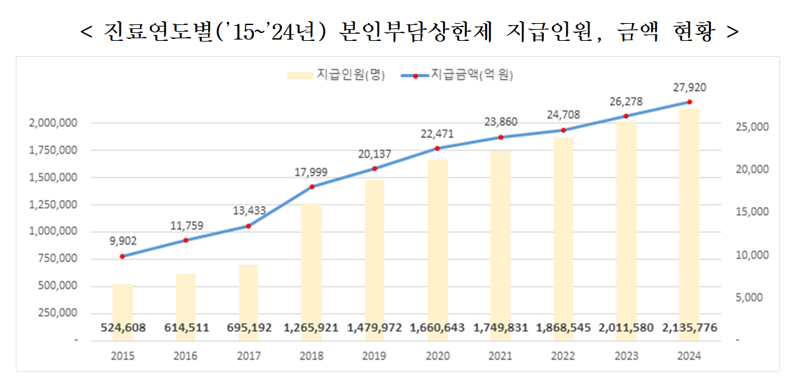
This is the result of a continuous average annual increase of 6% over the past five years. The average refund per person is about 1.31 million won, effectively reducing the medical expense burden for many patients.
Among the patients, 25,703 have already exceeded the maximum limit (8.08 million won) at the same medical institution, and 160.7 billion won was pre-paid by the institution directly to the corporation.
For the remaining patients, 1,085,660 who have registered a payment consent account will receive automatic refunds without a separate application process, while those without registered accounts will receive notifications from the corporation and will be paid sequentially after applying.
This statistic once again shows that the out-of-pocket limit system is providing concentrated benefits to the socially disadvantaged.
The bottom 50% income class accounted for 89% (1.9 million people) of the total recipients and 76.5% (2.1352 trillion won) of the payment amount. In particular, the lowest income class, the first quintile, accounted for 38.2% (814,875 people) of the total, receiving a total of 953.8 billion won in support. The amount allocated to the middle and upper-income classes in the 6th to 10th quintiles accounted for only 23.5% of the total.
By age, benefits were concentrated on the elderly. A total of 1,211,616 patients aged 65 and over received 1.844 trillion won, accounting for 66% of the total payment.
The elderly, who have high medical usage and a heavy burden of chronic diseases, have become the biggest beneficiaries of the out-of-pocket limit system. In contrast, 153,447 young people aged 19-39 received 135.6 billion won, accounting for only 5% of the total.
Kwon Byung-ki, Director of Essential Medical Support at the Ministry of Health and Welfare, said, "The out-of-pocket limit system has been confirmed to reduce the excessive medical expense burden on low-income and elderly people," and evaluated that "the system has great significance as a medical safety net."
Kim Nam-hoon, Executive Director of Benefits at the National Health Insurance Corporation, also emphasized, "It will be a reliable support for people experiencing difficulties due to unexpected medical expenses," and "we will continue to do our best to operate the system so that the public can receive treatment with peace of mind."
[email protected] Kang Jung-mo Reporter