First Quarter of This Year Facing Economic Recession... Smallest Increase in Wage Jobs 'Record Low'
- Input
- 2025-08-26 12:00:00
- Updated
- 2025-08-26 12:00:00
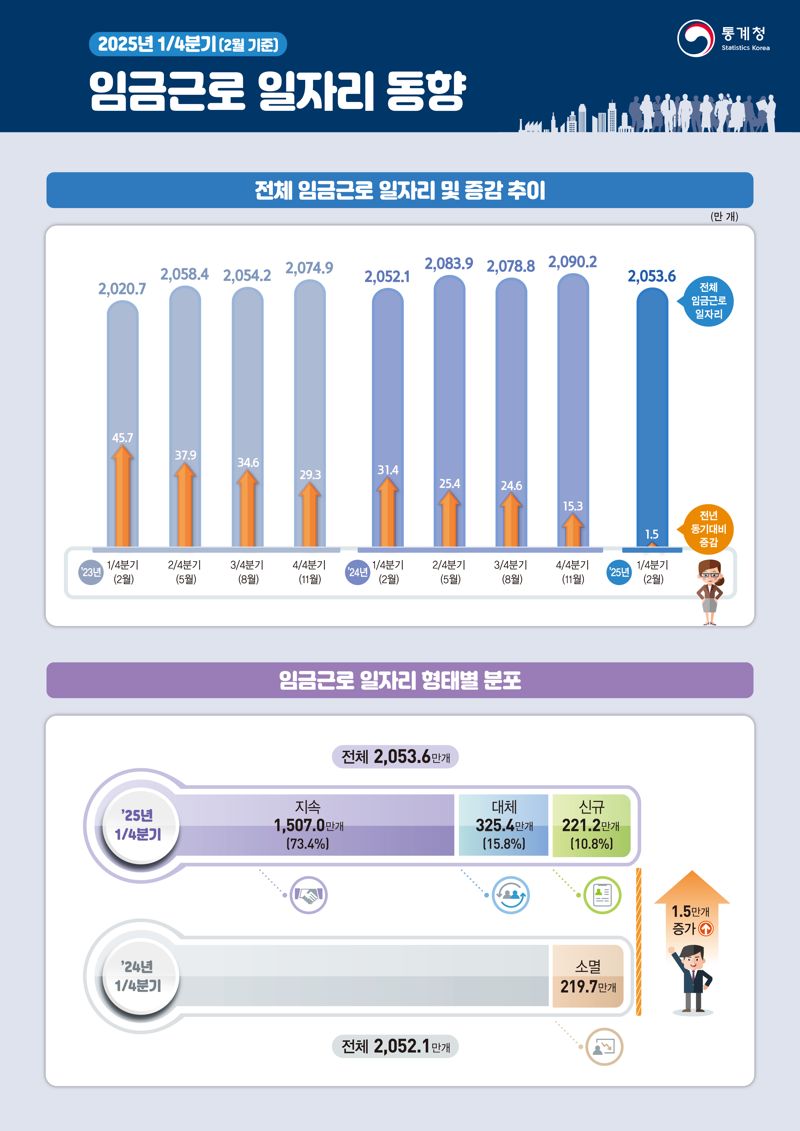
[Financial News] The first quarter of this year recorded the smallest increase in wage jobs on record. This is due to a significant decrease in construction jobs, which is a cause of domestic demand slump due to the construction industry recession. Retail jobs also turned to decrease for the first time since statistics began. Manufacturing jobs, closely linked to exports, also recorded a negative. In terms of jobs by generation, jobs for those in their 20s and below continue to decrease, exacerbating youth employment instability.
According to Statistics Korea's 'First Quarter (February basis) Wage Employment Trends' on the 26th, the total number of wage jobs in the first quarter was 20,536,000, an increase of 15,000 compared to the same period last year.
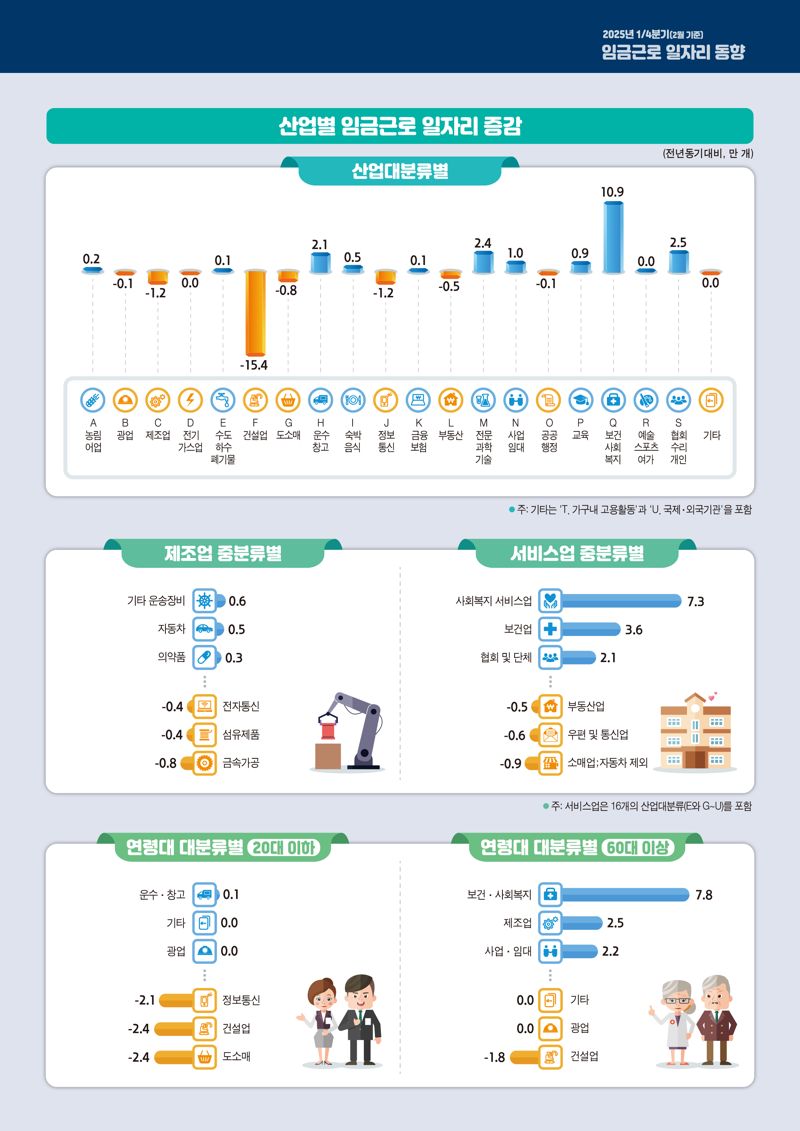
The increase in jobs was driven by health and social welfare (109,000), associations, repairs, and personal (25,000), and professional, scientific, and technical (24,000). However, it is the smallest increase since statistics began in 2017. The increase in wage jobs was △314,000 in the first quarter of last year △254,000 in the second quarter △246,000 in the third quarter △153,000 in the fourth quarter, gradually decreasing and plummeting in the first quarter of this year.
The main reason for the sharp decrease in the increase in wage jobs is the contraction of the construction industry. The construction industry decreased by 154,000 compared to the same period last year, recording the largest decrease on record. Construction wage jobs have decreased for six consecutive quarters since the fourth quarter of 2023.
Due to the decrease in consumption, wholesale and retail wage jobs also decreased by 8,000 compared to the same period last year, turning to a decrease for the first time since statistics began. Among wholesale and retail, general retail decreased by 9,000 and wholesale of building materials and heating equipment decreased by 2,000, affecting the overall decrease.
The expansion of external uncertainty due to the Korea-US tariff negotiations at the beginning of this year and sluggish exports also negatively affected manufacturing wage jobs.
Manufacturing decreased by 12,000 compared to the same period last year, reducing the growth trend that had continued since the second quarter of 2021. As manufacturing (20.9%) has the largest share in the proportion of jobs by industry, it suppressed the overall job growth trend. Specifically, electronic components (-7,000), structural metal products (-5,000), and other metal processing products (-3,000) decreased.
Wage jobs by age group decreased for those in their 20s and below (-168,000) and those in their 40s (-100,000). On the other hand, those in their 60s and above (197,000), those in their 30s (64,000), and those in their 50s (21,000) increased. Those in their 60s and above increased in health and social welfare (78,000), manufacturing (25,000), and business and rental (22,000). Those in their 20s and below decreased in wholesale and retail (-24,000), construction (-24,000), and information and communication (-21,000).
A Statistics Korea official said, "Wage jobs for those in their 20s have been on a negative trend since the fourth quarter of 2022. The decrease in the 20s is the largest on record," adding, "While the economic downturn is a cause, the structural decrease in the population in their 20s has a significant impact. As the population in their 20s moves to their 30s, jobs in their 30s have increased." He continued, "Jobs in health and social welfare used to increase by 130,000 to 140,000 in the past, but this year it has slowed to around 100,000," adding, "This is due to the impact of many government job projects last year."
[email protected] Choi Yong-jun Reporter