Second Amendment to Commercial Act Passed by Democratic Party Leadership... Opposition "President Lee Should Exercise Veto"
- Input
- 2025-08-25 14:13:36
- Updated
- 2025-08-25 14:13:36
'Stronger' Second Amendment to Commercial Act Passed in National Assembly on 25th
Mandatory Cumulative Voting System and Expanded Separate Election of Audit Committee Members
Ruling Party "One Step Closer to Achieving KOSPI 5000" Opposition "Economic Rebellion Law Bringing Massive Aftermath"
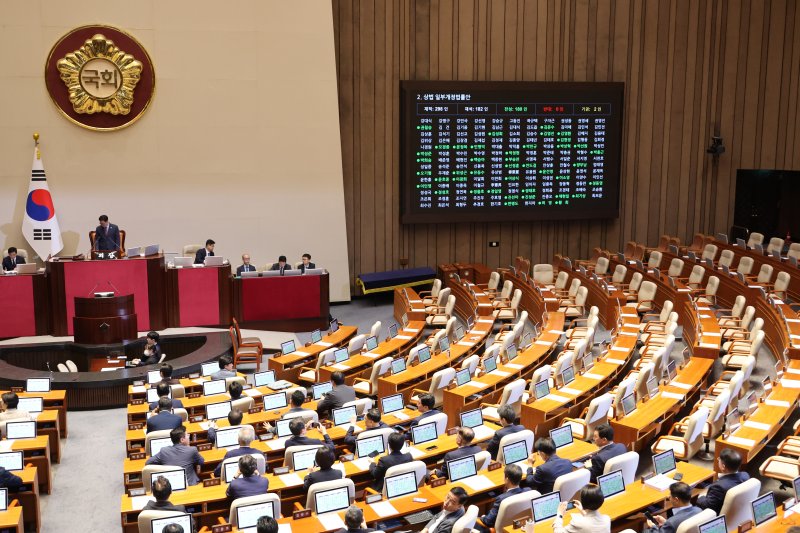
[Financial News] The strengthened second amendment to the Commercial Act passed the threshold of the National Assembly under the leadership of the Democratic Party on the 25th. The People Power Party resisted with a filibuster (unlimited debate to obstruct proceedings under the National Assembly Act), but the ruling bloc, which secured more than 180 seats, ended it and processed the second amendment to the Commercial Act.
The National Assembly put the bill to a vote at the plenary session that day, and out of 182 members present, 180 voted in favor, and 2 abstained, thus passing the second amendment to the Commercial Act. The ruling Democratic Party and allied parties cast their votes in favor, while the People Power Party, which opposed it as an 'economic rebellion law', did not participate in the vote. The business community expressed concerns that it would make it difficult to defend management rights, but it passed the National Assembly plenary session under the leadership of the Democratic Party.
Previously, on the 24th, when the second amendment to the Commercial Act was introduced to the plenary session, the People Power Party defined it as a 'corporate strangulation' bill and started a filibuster. However, the Democratic Party immediately submitted a motion to end the filibuster, and 24 hours later, the debate was concluded with a vote in favor of ending it, and the bill vote followed.
Previously, on July 3rd, the amendment to the Commercial Act, which included expanding the duty of loyalty of directors from the company to shareholders and introducing independent directors, was passed first, and the second amendment to the Commercial Act processed that day mandates the introduction of a cumulative voting system for listed companies with assets of 2 trillion won or more and expands the separate election of audit committee members from the existing 1 to 2 or more.
The Democratic Party stated that with the passage of the second amendment to the Commercial Act, the 'Korea discount' will be resolved and 'KOSPI 5000 achievement' is one step closer. Kim Hyun-jung, the Democratic Party's floor spokesperson, emphasized at a briefing held at the National Assembly Communication Center that day, "The second amendment to the Commercial Act is a package bill of the first amendment to the Commercial Act and a follow-up bill that ensures its effectiveness."
Spokesperson Kim said, "The People Power Party, which supported the first amendment to the Commercial Act, opposed the second amendment and launched a filibuster," adding, "This is a logical contradiction and self-denial, and it is no different from revealing the intention to render the first amendment to the Commercial Act ineffective." He continued, "Even if the People Power Party's obstruction and hindrance continue, the Democratic Party will take the lead in solving the remaining tasks for the advancement of the Korean capital market and the achievement of KOSPI 5000."
The People Power Party strongly opposed. In particular, they urged President Lee Jae-myung to exercise the right to request reconsideration (veto) on the Yellow Envelope Act (Amendments to the Labor Union and Labor Relations Adjustment Act Articles 2 and 3) and the second amendment to the Commercial Act, which passed the National Assembly on the 24th.
Song Eon-seok, the People Power Party's emergency committee chairman and floor leader, held a general meeting of lawmakers at the National Assembly that day, saying, "Is this a biological experiment on the national economy and people's livelihood economy?" and "With the Yellow Envelope Act and the stronger Commercial Act, the Korean economy will plummet." Chairman Song especially pointed out, "The Yellow Envelope Act and the stronger Commercial Act will bring about a massive aftermath to the economic order, dampening corporate investment enthusiasm, driving them overseas, reducing youth jobs, and losing economic growth momentum. What else can the Democratic Party, which forcibly passes such laws, be if not an economic rebellion force?"
[email protected] Choi Jong-geun, Lee Ha-ram reporters