[fn Editorial] Yellow Envelope Act Finally Passed, Concerns About Companies Leaving Korea
- Input
- 2025-08-24 19:10:41
- Updated
- 2025-08-24 19:10:41
Despite Business Opposition, Bill Passed in National Assembly on 24th
Supplementary Legislation Needed If Labor Market Chaos Occurs
Supplementary Legislation Needed If Labor Market Chaos Occurs
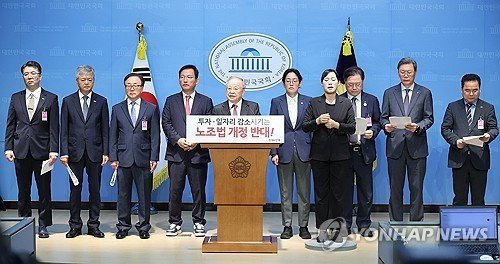
However, the business community, which opposed the bill until the end, is deeply concerned. It is still difficult to accurately predict what impact the Yellow Envelope Act will have on the Korean economy. The business community expressed fear that the quiet departure of our companies due to the Yellow Envelope Act is the most worrisome. Therefore, while monitoring the aftermath of the Yellow Envelope Act, which has been passed, we should not hesitate to supplement or amend the law if necessary.
The government and the ruling party have only emphasized the positive effects of the Yellow Envelope Act. They have argued for its legitimacy with the logic that if the right to negotiate before a strike is guaranteed, strikes will decrease and productivity will improve. They also argued that if subcontracted unions have a channel to communicate with the main contractor, they will not rely on the extreme measure of illegal strikes, and productivity will increase.
On the other hand, the business community has been concerned about the industrial chaos that the Yellow Envelope Act may cause. If dozens or hundreds of subcontracted unions demand negotiations, the main contractor may not be able to respond to each one, leading to extreme chaos in the industrial field. They worried that the expansion of the scope of users and the concept of labor disputes could lead to mass strikes, and instead of improving productivity, labor and management could perish together.
Both domestic and foreign companies' potential departure should be closely monitored. Foreign companies that have invested in Korea have pointed out the lack of flexibility in the Korean labor market as the worst investment environment, and they have indicated that the Yellow Envelope Act will further worsen this rigid labor market. The possibility of withdrawal of companies like GM Daewoo, which had rumors of withdrawal even before the bill was passed, has increased.
The departure of domestic companies actively investing abroad due to tariff issues could deepen with the passage of the Yellow Envelope Act, and if that happens, the problem of industrial hollowing out will become more serious. Attracting foreign companies to Korea and retaining our companies is essential to maintain the domestic industrial ecosystem and protect jobs, but it is very concerning what result the Yellow Envelope Act will bring.
Korean companies are already suffering from strikes. If subcontracted unions' strikes explode, not only will management become difficult, but companies may also close. Whether the productivity improvement promised by the government will be realized or whether the extreme chaos feared by the business community will occur remains to be seen. After observing the movements in the labor field, if the positive functions are small and the feared side effects increase, we urge once again to immediately start the process of amending the law.
The Yellow Envelope Act has now been passed. The government still insists that the Yellow Envelope Act is the 'real growth law.' Since the bill has been passed, to prove this statement true, the government should focus its capabilities on implementing it in a way that benefits both labor and management. If the protection of workers' rights and the maintenance of corporate competitiveness are achieved, it can certainly be considered a success.
The government plans to form a task force (TF) to support the stable implementation of the Yellow Envelope Act. During the operation of the TF, the government should listen to the opinions of the business community, which have not been reflected at all so far, to minimize the disadvantages to companies and the chaos in the labor field.