[fn Editorial] Joint Korea-Japan Statement After 17 Years, To Be Continued with Practical Cooperation
- Input
- 2025-08-24 19:10:39
- Updated
- 2025-08-24 19:10:39
Summit Meeting of the Two Countries "Expansion of Cooperation in Future Industries"
Korea-U.S. Meeting Also with National Interest as Priority
Korea-U.S. Meeting Also with National Interest as Priority
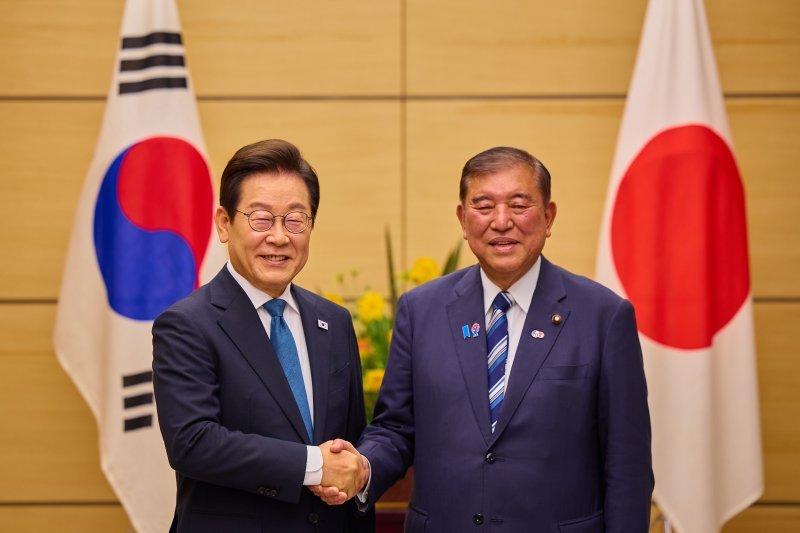
The achievements of the summit meeting, which emphasized a future-oriented Korea-Japan relationship without mentioning various sensitive issues such as historical problems, are quite significant. Now, 80 years after liberation and 60 years after the normalization of diplomatic relations between Korea and Japan, the two countries are not in a leisurely situation to argue over past and present issues. This is because they face common challenges such as North Korea's nuclear threat and security issues like the North Korea-Russia closeness, as well as the imposition of tariffs by the United States.
In the rapidly changing international situation, the separation of security and economic responses and pragmatic diplomacy apply to both countries. While Korea-U.S.-Japan cooperation should be strengthened in terms of security, in trade issues, the distinction between enemies and allies has disappeared, and Korea and Japan need to join forces to respond to U.S. protectionism.
Moreover, the U.S.-China hegemony struggle has ultimately resulted in raising the technological level of both countries, reaching a point where Korea and Japan must cooperate to counter it. The promise made by the Korea-Japan leaders to expand cooperation in future industries such as hydrogen and artificial intelligence (AI) is for this reason. The two countries have common social issues such as low growth, low birthrate, and population concentration, and if they discuss and share solutions together, they can achieve a synergistic effect. Of course, this does not mean completely excluding historical issues such as the comfort women and Dokdo issues. It means to postpone discussions temporarily to strengthen cooperation.
President Lee will arrive in the United States and hold a Korea-U.S. summit meeting with U.S. President Donald Trump on the 25th (local time). They will discuss the remaining issues of the tariff negotiations concluded at the end of last month, and security cooperation will also be on the agenda. In the summit meeting with the United States, President Lee must thoroughly place national interest as the top priority in discussing current issues.
While it seems likely that Korea-U.S.-Japan cooperation will be reaffirmed in terms of security, there is a high possibility of differing opinions on issues such as the cost of stationing U.S. troops in Korea and the redeployment of U.S. forces. Even if concessions cannot be avoided, it is necessary to demonstrate confident summit diplomacy that minimizes them. Especially in tariff issues, President Trump may make unreasonable demands regarding the import of agricultural products such as beef. The goal of this meeting should be to firmly draw the line, block unreasonable demands, and secure favorable results for us.
The impact of the U.S. reciprocal tariffs, such as the sharp decline in Korean automobile exports to the U.S., is already affecting our economy. If we accept unreasonable U.S. demands here, our economy could fall into an uncontrollable abyss. Therefore, President Lee's diplomatic tour of the U.S. and Japan is more important than any other summit diplomacy.