"The Era When the U.S. as Mediator Became a Risk, New Phase for Korea-Japan Relations"...Kimiyama Tadashi, Honorary Professor at the University of Tokyo
- Input
- 2025-08-24 10:00:00
- Updated
- 2025-08-24 10:00:00
Interview with Kimiyama Tadashi, Honorary Professor who studied the Korean Peninsula for over 40 years
"If the U.S. was a mediator in the past, now Korea and Japan share the perception of responding to the U.S. together"
"'Stable Development' Agreement, New Keyword for Managing Korea-Japan Relations"
"Build Practical Benefits with Agendas on Economic Security, Technology, and Youth Exchange"
"Post-Ishiba Structure, Korea-Japan Relations at a Crossroads Depending on the Nature of the Next Regime"
"If the U.S. was a mediator in the past, now Korea and Japan share the perception of responding to the U.S. together"
"'Stable Development' Agreement, New Keyword for Managing Korea-Japan Relations"
"Build Practical Benefits with Agendas on Economic Security, Technology, and Youth Exchange"
"Post-Ishiba Structure, Korea-Japan Relations at a Crossroads Depending on the Nature of the Next Regime"
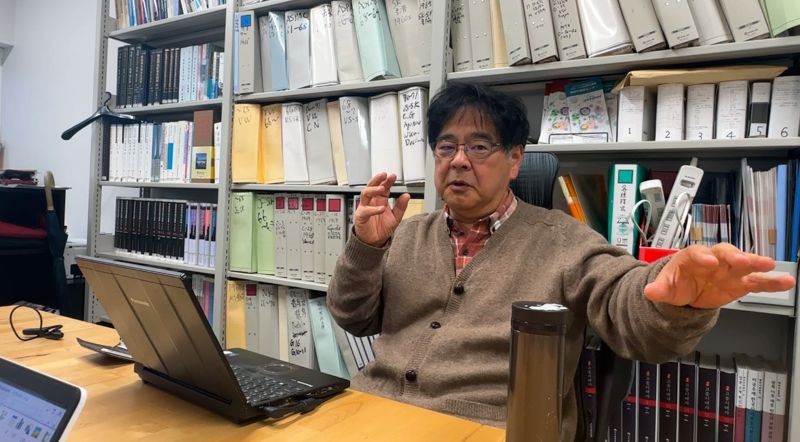
【Tokyo=Kim Kyung-min Correspondent】 The structure of Korea-U.S.-Japan relations is changing. In the past, the U.S. played the role of mediator in unstable Korea-Japan relations, but since the Donald Trump era, with the rise of 'U.S. risk' such as tariffs and defense cost sharing, the need for Korea and Japan to respond together has increased. The Korea-Japan summit held on the 23rd also highlights 'cooperation on common tasks' amid these structural changes.
Kimiyama Tadashi, a prominent pro-Korean scholar in Japan and Honorary Professor at the University of Tokyo, emphasized in a phone interview with us on the 24th, "This summit was not one to expect great results due to the short preparation period, but the introduction of the term 'stable development' was impressive." He said, "It is a significant advancement that there was an agreement to manage relations stably, unlike in the past when relations were shaken with each regime change."
―President Lee Jae-myung chose Japan for his first overseas bilateral summit 80 days after taking office. What is the significance?
▲There is precedent in the past. In November 1961, then Chairman of the Supreme Council for National Reconstruction Park Chung-hee stopped by Japan to meet Prime Minister Ikeda Hayato on his way to the U.S. At that time, the U.S. was mediating, but now it is different. Under the Trump 2nd term, risks such as tariffs and defense costs increased, and there is a shared perception that Korea and Japan need to cooperate to respond. The Ishiba government also shares this perspective.
―The historical issue was omitted from the agenda. How do you see the direction of resolution?
▲Just confirming the succession of the 'Korea-Japan Partnership Declaration' in this summit is meaningful. Historical issues have been postponed, and for now, the economy and security take precedence. If relations improve further, historical issues can be addressed.
―Which part of the summit agenda can be the driving force for bilateral relations?
▲Economic security, technological cooperation, and youth exchange all hold promise. Accumulating substantial results will strengthen the relationship.
―Is there a possibility of a new declaration surpassing the Kim Dae-jung-Obuchi Joint Declaration?
▲Whether the Ishiba government can continue as a long-term regime is crucial. If the next regime inherits the current cabinet, including Chief Cabinet Secretary Hayashi Yoshimasa, it is possible, but if the far-right takes power, it will be difficult.
―What is the geopolitical significance of this summit?
▲There was an agreement that the two countries should cooperate on the North Korean nuclear issue. Even if President Lee sends a soft message to North Korea, there is expected to be backlash from North Korea because the nuclear issue was addressed. The response to China varies slightly among the three countries (Korea-U.S.-Japan). The U.S. is consistently hardline, Japan is relatively less so, and Korea is softer than Japan. The new Korean government may be reluctant to actively respond to China.
―What are the tasks for further solid development of Korea-Japan relations?
▲We need to accumulate practical benefits in strategic security and economic cooperation. While solving common tasks, we must share the perception that we are important partners. We need to build the 'strength of Korea-Japan relations.' This summit marks the first step.
―How do you evaluate President Lee's diplomacy?
▲Unlike former Presidents Moon Jae-in and Yoon Seok-youl, who pursued ideologically biased diplomacy, President Lee emphasized national interest and pragmatism. It is positive in the short term, but we need to see what big picture he will present in the long term.
―What impact will the summit results have on the Ishiba cabinet's approval rating?
▲In Japan, diplomatic achievements do not significantly affect approval ratings. However, there will be no negative effects. It may have a slightly positive effect. Although there is pressure to resign, Prime Minister Ishiba Shigeru is determined to maintain his regime and will not easily step down.
―What is your outlook on the 'post-Ishiba' structure?
▲If the Ishiba government maintains its approval rating and steps down, Chief Cabinet Secretary Hayashi is considered a strong candidate. However, if the approval rating drops, it becomes difficult to predict. The direction of Korea-Japan relations will also change depending on the nature of the next regime.
[email protected] Kim Kyung-min Reporter