[Exclusive] End of Camcorder Traffic Control in Scorching Sun... Patrol Car Interior 'Touch Only' with AI
- Input
- 2025-08-24 15:10:29
- Updated
- 2025-08-24 15:10:29
Existing 'Camcorder Method' Traffic Control Inconvenient, High Risk
Automatic Video Recording and Editing Using In-Car Camera
Future Goal to Integrate AI Functionality for Automatic Violation Detection
Planned Distribution in Second Half of This Year, Budget Secured for Next Year
Automatic Video Recording and Editing Using In-Car Camera
Future Goal to Integrate AI Functionality for Automatic Violation Detection
Planned Distribution in Second Half of This Year, Budget Secured for Next Year
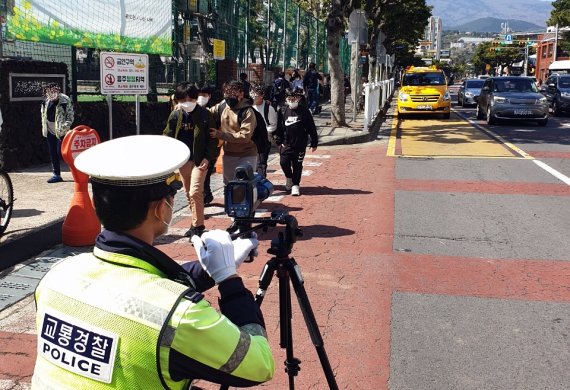
[Financial News] Seoul police are pushing to introduce equipment that can enforce traffic law violations from inside patrol cars using artificial intelligence (AI). The aim is to reduce the risk of having to conduct 'camcorder enforcement' while standing outside for long periods in extreme weather conditions like heatwaves, and to improve the accuracy of enforcement.
According to a comprehensive report by Financial News on the 24th, the traffic enforcement improvement plan being prepared by the Seoul Metropolitan Police Agency involves using existing cameras mounted at the front of patrol cars to detect traffic law violations. The police can then operate the camera and touch the screen to automatically record and edit the violation scene. This is essentially moving the camcorder enforcement inside the car, according to the police.
The plan is to make it easy to enforce various traffic law violations such as signal violations, centerline invasions, and illegal lane changes from inside the car. Ultimately, the goal is to develop a system that integrates AI analysis functions to automatically learn and classify types of traffic law violations.
Currently, traffic enforcement that can be conducted inside patrol cars is limited to 'speeding'. The Seoul Metropolitan Police Agency introduced vehicle-mounted enforcement equipment capable of speed enforcement in unmarked patrol cars last May. This system measures the speed of vehicles ahead using radar to automatically extract speeding violations, recognizes vehicle numbers with high-performance cameras, and transmits GPS location information and enforcement videos to the video room.
Other conventional traffic enforcement primarily involves fixed unmanned traffic enforcement equipment installed on roads and police officers directly holding camcorders to film violating vehicles. They are deployed at major accident-prone spots or habitual violation locations to enforce various traffic law violations such as △signal violations △illegal lane changes △centerline invasions.
However, this camcorder enforcement has been criticized for increasing the burden on frontline police officers and being ineffective in adverse weather conditions. Enforcement officers not only have to stand on the road for long periods to film violating vehicles, but they also have to manually edit the captured videos into necessary materials and transfer them to the internal network. This entire process is manual, making it complex and time-consuming.
Enforcement is also difficult when extreme weather conditions like heatwaves and heavy rain coincide. The safety issue for police officers has also been consistently raised. According to the police agency's summer work guidelines, when a heatwave advisory is issued and the perceived temperature is 33~35℃, vehicle patrols are conducted normally, but foot patrols and enforcement are restricted. Enforcement is suspended only when a heatwave warning is issued and the perceived temperature exceeds 35℃.
The improved equipment is expected to be available for pilot operation as early as the end of this year. The police have begun developing prototypes of enforcement equipment for use inside patrol cars in collaboration with some companies.
However, it has been identified that a separate budget for equipment introduction has not yet been allocated. The police are considering using the costs currently spent on purchasing and maintaining camcorders as a priority. Once the prototype development is completed, the plan is to secure some equipment through next year's local budget.
A police official said, "If the equipment is introduced, it will be possible to conduct enforcement regardless of the weather, and the enforcement process will become much simpler, reducing the fatigue of police officers," adding, "We plan to first equip 31 police station traffic patrol cars in Seoul for testing, and if the evaluation is favorable, we will expand the distribution."
[email protected] Jang Yuha Reporter