Uncertainty from Trump... Major 4 Groups' Lobbying in the US Surpasses $10 Million for the First Time in the First Half
- Input
- 2025-08-21 16:32:58
- Updated
- 2025-08-21 16:32:58
Analysis of Major 4 Groups' Lobbying in the US Congress in the First Half
21.4% ↑ in One Year... Samsung $3.71 Million
Mainly Focused on Tariffs, Supply Chains, Infrastructure
"Considering the Trump Administration's Traits, Lobbying is Necessary"
21.4% ↑ in One Year... Samsung $3.71 Million
Mainly Focused on Tariffs, Supply Chains, Infrastructure
"Considering the Trump Administration's Traits, Lobbying is Necessary"
Major 4 Groups' US Lobbying Amount $10.13 Million... Samsung Leads
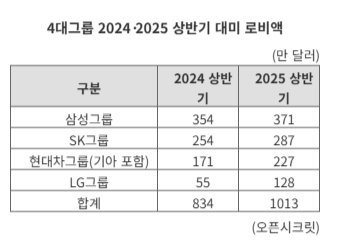
On the 21st, according to 'OpenSecrets', a nonprofit organization tracking lobbying funds in the US political and governmental circles, the lobbying amount of the major 4 domestic groups in the US Congress in the first half of this year was $10.13 million, a 21.4% increase compared to the same period last year ($8.34 million). In addition to the lobbying funds captured by OpenSecrets, it is believed that there are significant amounts of undisclosed indirect lobbying expenses, such as consulting contracts with consulting firms staffed by influential figures in the US political and governmental circles, and donations to influential think tanks. The largest amount of funds among the major 4 groups' US lobbying expenditure (totaling $10.13 million) was spent by Samsung, which spent $3.71 million. It was followed by SK Group with $2.87 million, Hyundai Motor Group with $2.27 million (Hyundai Motor $1.6 million, Kia $670,000), and LG Group with $1.28 million (LG Electronics $1.15 million, LG Corp. $130,000).
Most of their lobbying items focused on tariffs, supply chains, and electric vehicle support policies. Samsung Group conducted lobbying activities centered on Samsung Electronics North America, Samsung SDI North America, and Samsung Semiconductor. The lobbying content submitted by Samsung Electronics North America focused on digital infrastructure, STEM education, and vocational training and workforce development. It is interpreted as a desire to exert some influence when the US Congress and others create policies or allocate budgets related to these areas. SK Group is conducting lobbying activities through 'SK Americas', a North American integrated public affairs organization established early last year. SK Group focused its lobbying on trade restrictions and export controls, US supply chain policies, and the International Emergency Economic Powers Act (IEEPA). Given the nature of companies where exports occupy a large area, it is analyzed as a move to lead government policies in a favorable direction.
In addition, Hyundai Motor's expenditure includes lobbying costs for Boston Dynamics ($360,000) and the urban air mobility (UAM) corporation Supernal ($360,000), as well as Hyundai Steel ($140,000). In a situation where the market share of electric vehicles in the US is increasing, they are focusing their lobbying on electric vehicle and battery support policies, and IRA tax credit rules. LG Group's major affiliate LG Electronics increased its amount from $310,000 in the first half of last year to $1.15 million this year, a 271% surge. The lobbying content expanded from focusing on tariffs to supply chains and tax credit regulations.
Essential for Business Continuity... "Companies Need to Strengthen Activities"
The increase in US lobbying expenditures is attributed to the expansion of US investments and the strengthening dependence on the US market. In the case of Hyundai Motor Group, the US has surpassed Korea to become the number one sales market. The same applies to home appliance businesses like Samsung Electronics and LG Electronics. An industry insider said, "In the US, lobbying is legal and there are many regulations, so it's important to understand them and respond in a way that is favorable to the company," adding, "Through lobbying, companies can engage in various activities such as securing government projects." Professor Kim Tae-hwang of Myongji University's Department of International Trade said, "Considering the traits and problem-solving methods of the Trump administration, companies need to strengthen legitimate lobbying activities," adding, "They need to distinguish between effective and ineffective lobbyists, and grab the main line rather than a side line to enhance the effectiveness of lobbying." Professor Jeong Jae-hwan of Inha University's Department of Political Science and Diplomacy also stated, "Since current US policies fundamentally have various discriminatory measures, lobbying to gain an advantage is natural from a company's perspective," adding, "There can be types of lobbying that aim to reduce the constraints on oneself while increasing them on others. From this perspective, (lobbying) is effective for companies."
[email protected] Park Kyung-ho Kwon Joon-ho Reporter