HP Korea Launches 'Let's Go Digital' Campaign.. Announces Results of Domestic Digital Literacy Survey
- Input
- 2025-08-21 11:29:00
- Updated
- 2025-08-21 11:29:00
HP Korea announced on the 21st that it has officially launched the social contribution campaign 'Let's Go Digital' to bridge the digital divide among the elderly and has released the results of the first domestic digital literacy survey as its initial activity.
HP Korea's 'Let's Go Digital' campaign is designed to help the elderly, who are easily marginalized in the rapidly changing technological environment, understand digital technology more easily and use it beneficially in their daily lives. HP plans to continuously expand community-based education and support to help the elderly connect with society and become independent in the digital environment.
Kim Dae-hwan, CEO of HP Korea, said, "As a global leading technology company, HP aims to fulfill its social responsibility to create a digital world where no one is left behind," adding, "This campaign started as an extension of that vision, and we will continue to actively support various generations, including the elderly, to easily understand and utilize digital technology."
As the first step of this campaign, HP conducted a quantitative and qualitative survey on the digital literacy status of the elderly in Korea last May. The purpose is to understand the reality of the elderly, who are increasingly marginalized against the backdrop of rapidly evolving technology, and to suggest the necessity and direction of education to achieve digital equity. The survey targeted 600 'general adults' aged 20 to 59 living in the metropolitan area and 400 'elderly' aged 60 to 79, totaling 1,000 people, conducted through online and field surveys.
The survey results revealed that while digital technology is deeply embedded in our daily lives, awareness of the issue of technological inequality is commonly spreading across all age groups. 79% of general adults and 67% of the elderly agreed that "vulnerable groups such as the elderly are unable to adapt to digital changes," showing a social consensus on digital exclusion.
Additionally, in the case of smartphones, the most universal digital device, more than 98% of both general adults and the elderly reported having used them, but there was a clear generational gap in actual utilization skills beyond mere device distribution. Over 80% of general adults responded that they could use digital services independently, while less than 60% of the elderly said the same, indicating that challenges remain in achieving digital equity.
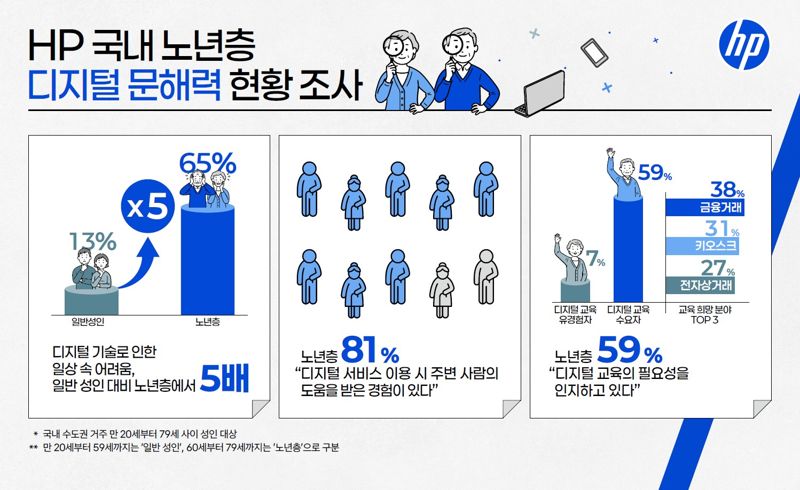
This gap in digital service utilization was found to lead to psychological burdens for the elderly beyond mere inconvenience. 65% of the elderly reported experiencing inconvenience in daily life due to not being able to use digital technology well, showing a rate five times higher than that of general adults (13%). Additionally, 81% of the elderly responded that they had received help from others when using digital services, and 28% said they left problems unresolved when they occurred.
Despite needing help in such situations, 63% of the elderly said they felt hesitant or burdened to ask for help from those around them when they needed assistance with digital services. This indicates a high dependency on digital technology and the existence of psychological barriers to requesting help, suggesting that the gap in digital technology utilization skills could lead to psychological shrinkage and social isolation for the elderly.
The structural issue of lack of educational opportunities was also found to have a significant impact on the elderly's inability to fully utilize digital technology. Only 7% of the elderly reported having received digital education, while more than 59% recognized the need for education. This shows that if an educational environment is created, more than half of the elderly are willing to voluntarily enhance their digital capabilities. The areas where the elderly hope to receive education include financial transactions (38%), kiosk use (31%), and product and service purchases (27%), indicating a need for practical digital education focused on areas closely related to daily life.
Based on the results of this survey, HP will produce educational booklets that the elderly can refer to in situations where they face technical difficulties in real life and distribute them to local welfare institutions and elderly communities to help them overcome difficulties in using technology on their own. These booklets will be centered on how to use various electronic devices such as PCs, printers, and kiosks, as well as situations utilizing smartphones like calling a taxi through an app and internet banking. Additionally, tailored educational guides prepared mainly on the items the elderly wished to learn and explanations of key digital terms will be included to provide practical help.
HP announced that it plans to continue the 'Let's Go Digital' campaign by operating digital education sessions for the elderly in cooperation with the Korea Senior Citizens Association Seoul Federation in the second half of this year based on the educational materials.
[email protected] Koo Ja-yun Reporter