"Tattooists are professionals too" Can they enter the institutional framework?
- Input
- 2025-08-20 15:10:22
- Updated
- 2025-08-20 15:10:22
On the 20th, a press conference was held in front of the National Assembly in Yeouido, Seoul, urging the passage of the Tattooist Law
Participation of Park Jumin, the chairman of the Health and Welfare Committee, who proposed the Tattooist Law
The Tattooist Law is a bill that legalizes tattooing by non-medical personnel
"Currently, most procedures are conducted underground"
"The larger the legal gap, the greater the consumer harm such as hygiene accidents"
Participation of Park Jumin, the chairman of the Health and Welfare Committee, who proposed the Tattooist Law
The Tattooist Law is a bill that legalizes tattooing by non-medical personnel
"Currently, most procedures are conducted underground"
"The larger the legal gap, the greater the consumer harm such as hygiene accidents"
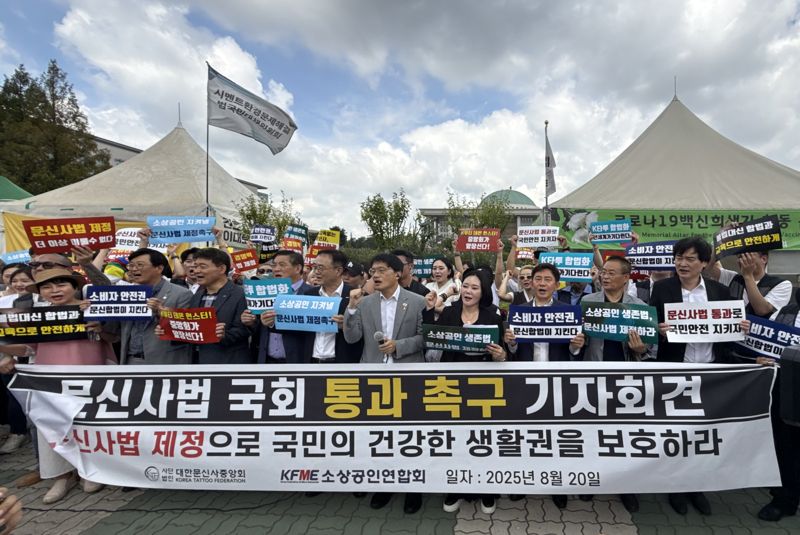
[Financial News] "Enact the Tattooist Law for the survival of small businesses! Ensure safety through legality and education instead of illegality!"
Im Boran, president of the Korea Tattooist Central Association, held a press conference on the 20th in front of the National Assembly in Yeouido, Seoul, urging the passage of the Tattooist Law, saying, "We have fought tirelessly for the institutionalization of tattooists for the past 12 years," and "We welcome the Tattooist Law being submitted to the second subcommittee of the Health and Welfare Committee. If it passes the subcommittee, it will be a historic turning point where tattooists are recognized as a profession with legal status," raising his voice for the swift passage of the bill.
The Tattooist Law is a bill that legalizes tattooing by non-medical personnel and recognizes tattooists as a professional occupation. On this day, the press conference was attended by △Park Jumin, the chairman of the Health and Welfare Committee who proposed the Tattooist Law △Song Chi-young, president of the Small Business Association △Heads of industry groups △Members of the Korea Tattooist Central Association, and more than 100 people.
Park Jumin, the chairman of the Health and Welfare Committee, said, "During my time as a lawyer, I saw many cases where non-medical tattooing was illegal and most procedures were conducted underground without management," and "I thought we should overcome the contradiction between reality and the system."
Park Jumin further stated, "I am now in my third term, but I have proposed the bill every time since my first term. During my first term, it was not even discussed, and during my second term, a public hearing was held by the Health and Welfare Committee," adding, "Now in my third term, I will do my best to ensure the bill passes so that we no longer have to hold press conferences like today."
Song Chi-young, president of the Small Business Association, said, "Most of those working in the tattoo industry are small business owners," and "If the bill passes, more than 100,000 workers will be able to obtain business licenses in a legal environment and engage in economic activities stably."
On this day, tattooists unanimously shouted that the profession of 'tattooist' should be legally recognized and protected by the system. Kang Se-wook, CEO of Pionis, a tattooist, said, "I don't want to earn money illegally," and "I want to work confidently and legally, pay taxes with the money I earn diligently, and work within the system."
There were also voices that the bill should be passed not only for the industry workers but also for public safety. Another tattooist, Han Seung-hee, director of Hantam, said, "For 10 years, I have drawn a single eyebrow or eyeliner line for countless people, feeling the impact a single touch can have on a person's life," and "As it is a profession that has a significant impact on someone, the state should now recognize the profession of tattooist and protect it institutionally."
Han continued, "The larger the legal gap, the more consumer harm occurs, such as hygiene accidents by non-experts," emphasizing, "Legislation is not for the benefit of the industry but a measure for public safety, consumer rights, and the trust of the K-beauty industry."
[email protected] Choi Hye-rim reporter