Reducing Too Many Teachers Harms Students
- Input
- 2025-08-19 15:57:19
- Updated
- 2025-08-19 15:57:19
Jeong Geun-sik, Seoul Metropolitan Office of Education Superintendent, Announces Statement
Calls for Reassessment of Teacher Reduction in Seoul
Some Say 46% of Teachers Handle 3 Subjects
Higher Reduction Rate Than Other Regions
[Financial News] #. A high school in Gangseo-gu saw a decrease of 39 students in 2025 compared to the previous year, but lost 3 classes and reduced 6 teachers. As a result, the number of students per class increased from 24.7 to 26.6. The more serious issue is that with the full implementation of the high school credit system, 46% of teachers at this school are teaching more than 3 subjects, and 92% are responsible for more than 2 subjects.
Jeong Geun-sik, Superintendent of Seoul Metropolitan Office of Education, issued a statement on the 19th expressing strong regret and concern regarding the Ministry of Education's first allocation notice for the 2026 academic year elementary and secondary teacher quota, urging a reassessment of the teacher reduction.
According to the Seoul Metropolitan Office of Education, the reduction in the number of elementary and secondary teachers in the Seoul area has averaged 1,000 annually over the past three years. Specifically, 558 elementary and 401 secondary teachers have been reduced. Superintendent Jeong requested to reduce the elementary teacher reduction rate from the current trend of 2.9% to 1.7% and to freeze the secondary teacher reduction rate at 2.5%.
Superintendent Jeong emphasized, "The previous government mechanically reduced teacher quotas based on the simple logic that a decrease in student numbers equals a reduction in teacher quotas," adding, "This has led to repeated confusion in the educational field every year, and the anxiety among teachers has intensified."
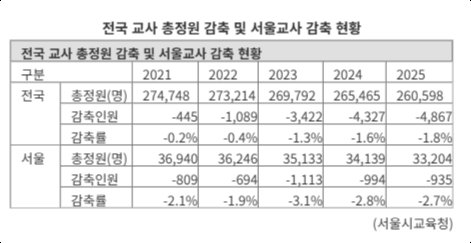
Over the past five years, the total number of teachers nationwide has decreased by an average of 1.1%, while the number of teachers in Seoul has decreased by an average of 2.6%, more than twice as fast. The annual teacher reduction rates were 3.1% (1,113 teachers) in the 2023 academic year, 2.8% (994 teachers) in the 2024 academic year, and 2.7% (935 teachers) in the 2025 academic year, showing a similar trend.
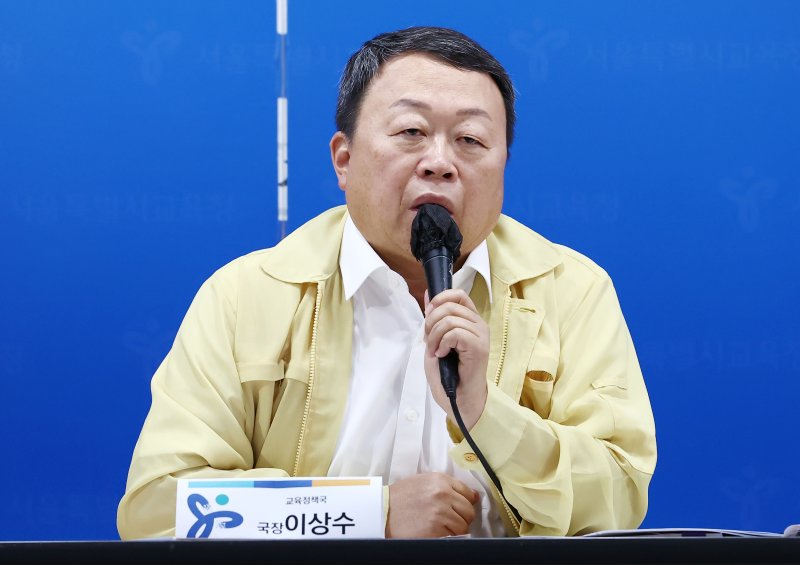
Lee Sang-su, Director of Education Policy at Seoul Metropolitan Office of Education, explained, "In particular, in the case of secondary schools, reducing teacher quotas more than the student reduction rate has significantly shrunk student-centered educational activities due to an increase in the number of students per class." He also expressed concern that "if the large-scale reduction trend continues in the 2026 academic year, school educational activities will be virtually devastated."
The Seoul Metropolitan Office of Education argues that considering Seoul's unique educational demands, such as AI education, the high school credit system, multicultural student support, and basic academic guidance, a simple reduction based on student numbers does not reflect the field situation. The office emphasizes the need for an appropriate number of staff to promote various educational policies.
In frontline elementary schools, the continuation of the Ministry of Education's 3% teacher reduction over the past three years has directly led to a reduction in the number of classes, exacerbating field difficulties. Especially, tailored support for multicultural students, which increased 2.2 times over 10 years, and 4.3% of students requiring basic academic support is desperately needed, but the current teacher quota makes it difficult to provide sufficient manpower support.
In middle and high schools, the number of students increased in the 2025 academic year, but the number of teachers and classes sharply decreased, leading to an increase in overcrowded classes. As a result, despite the implementation of the high school credit system, the burden on teachers to teach multiple subjects has increased, raising concerns about the decline in the quality of public education. Additionally, differences in educational demand by region lead to differences in school size, resulting in learning opportunities and educational disparities.
Director Lee pointed out, "While proposing policies and laws to protect teacher rights and provide tailored education to students, the reduction of teacher quotas, which is the foundation of school education, has shown a move contrary to the policy's goals." He argued that "preemptively reducing teachers due to the anticipated decrease in student numbers results in current students not receiving high-quality education," adding, "This is a clear harm directly inflicted on the educational community, including students, parents, and teachers who are dedicated to protecting the educational field."
Experts point out that in a situation where the number of elementary students is expected to bottom out in 2033 and secondary students in 2039 and then rebound, it is not desirable to establish teacher supply policies based on short-term student reductions.
monarch@fnnews.com Kim Man-ki Reporter