[fn Editorial] Yellow Envelope Act that Could Ruin Businesses, Hope for Compromise with Business Community's Amendment
- Input
- 2025-08-18 19:14:08
- Updated
- 2025-08-18 19:14:08
Six Economic Organizations Announce Joint Statement at National Assembly
Conditions such as 1-year Delay in Law Enforcement Must Be Accepted
Conditions such as 1-year Delay in Law Enforcement Must Be Accepted
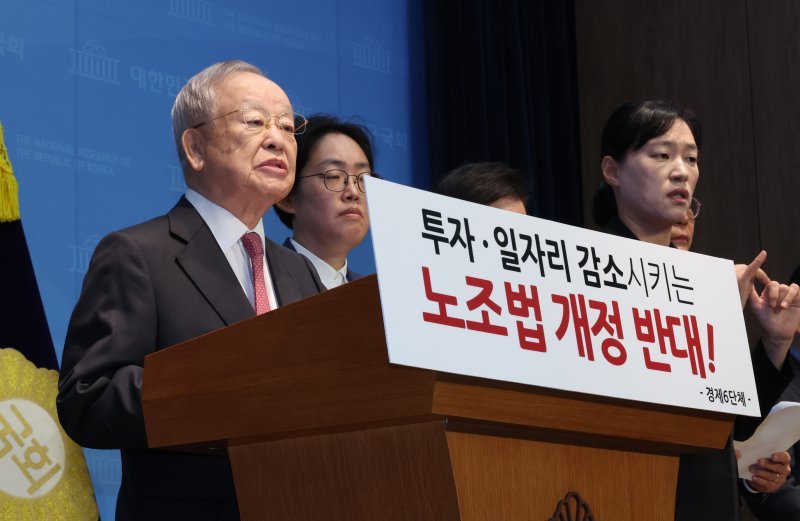
The Yellow Envelope Act has imposed a wrong frame on businesses from the legislative stage. Public opinion has been distorted as if the Yellow Envelope Act is being blocked to protect corporate vested interests. However, the reason the business community opposes the Yellow Envelope Act is for the long-term enhancement of national competitiveness. The expansion of the scope of users and the concept of labor disputes contained in the Yellow Envelope Act pose a great risk of directly impacting the competitiveness of our country's key industries such as automobiles, shipbuilding, steel, and construction. Furthermore, if this bill passes as it is, it will result in a situation where the primary contractor must engage in individual negotiations with dozens or hundreds of subcontractor unions in industries with multi-tiered subcontracting structures.
Despite knowing the harm of such a bill, the business community has made a big concession and proposed a compromise. If the political sphere fully understands this position of the business community, they should respond with a forward-looking attitude of compromise. In fact, the conditional alternative proposed by the business community does not deny the fundamental purpose of the bill. The amendment proposed by the six economic organizations includes setting a cap on damages for illegal strikes initiated by unions in the enforcement decree and prohibiting wage garnishment. It is a rational alternative that does not undermine the purpose of the Yellow Envelope Act, which is to prevent excessive burdens on workers from damages.
The issue lies in the expansion of the scope of users. The business community maintains the position that this matter should be resolved through the current law. Additionally, they urge that 'business management decisions' be excluded from the subject of labor disputes. To ensure that companies can conduct normal business activities, these two points must be adhered to.
The business community's demand for at least a one-year delay in implementation is also seen as a reasonable proposal. This is because it is an attitude of conditional acceptance rather than outright denial of the Yellow Envelope Act. It is a significantly advanced proposal from a complete rejection. However, if the Yellow Envelope Act is actually implemented, considerable confusion in the management field is inevitable. Therefore, extending the implementation period of the bill to sufficiently respond to such radical institutional changes as the Yellow Envelope Act is considered very desirable.
Despite the business community proposing a step-back alternative, the ruling party is poised to push through the bill's passage. It is frustrating to think about how they will handle the aftermath of the situation that will unfold. This is because not only domestic companies but also foreign investment companies are strongly opposing it. Several foreign companies have already expressed concerns about the implementation of the Yellow Envelope Act in Korea and have hinted at the possibility of reconsidering their investments.
Now the ball is in the political court. While the ruling party emphasizes the purpose of the Yellow Envelope Act, for reform to succeed, social consensus must be supported. Rather than unilateral pushing, finding a path of coexistence through dialogue and compromise is the true spirit of cooperative governance. If the business community's conditional proposal is rejected and the original bill is pushed through, resulting in management chaos, the loss will be passed on to the public. In the process of handling the Yellow Envelope Act, our society must cultivate the spirit of cooperative governance. Hopefully, we will not go down a path of mutual destruction.