[Exclusive] Legislation to Institutionalize 'Limited Unconstitutionality Decision Retrial Request'... Part of Judicial Branch Check
- Input
- 2025-08-18 16:48:58
- Updated
- 2025-08-18 16:48:58
Representative Yoon Gun-young, Promotes Codification of Limited Unconstitutionality Decision as Retrial Reason
"Expecting Rights Relief and Unified Constitutional Interpretation Without Introducing Judicial Review System"
"Expecting Rights Relief and Unified Constitutional Interpretation Without Introducing Judicial Review System"
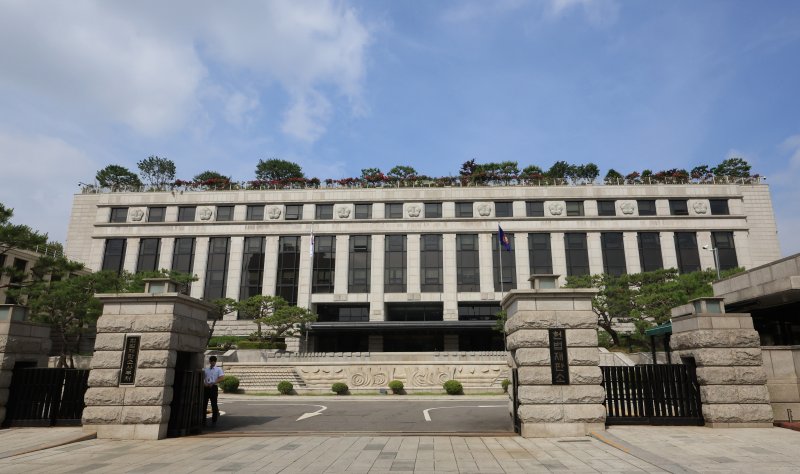
[Financial News] A bill is being promoted to codify the 'Limited Unconstitutionality Decision' made by the Constitutional Court as a reason for retrial. This will reduce situations where the judiciary ignores the decisions of the Constitutional Court. It is understood as part of the ruling party's policy direction to strengthen the authority of the Constitutional Court while weakening the power of the judiciary.
According to Financial News coverage on the 18th, Representative Yoon Gun-young of the Democratic Party of Korea, a member of the National Assembly's Public Administration and Security Committee, will soon propose a 'Partial Amendment to the Constitutional Court Act' with this content as the main point.
The Limited Unconstitutionality Decision is a decision that does not invalidate a specific legal provision but limits the scope of interpretation by stating 'if this provision is interpreted in method A, it is unconstitutional.' It is a method of preserving the legal text while cutting out only the unconstitutional interpretation, and the Constitutional Court has utilized this considering the 'principle of presumption of constitutionality.' The Constitutional Court sees itself as presenting the constitutional standard for legal interpretation.
However, the Supreme Court, the highest institution of the judiciary, holds the position that the authority for legal interpretation is exclusively vested in the courts. Therefore, there have been many cases where the binding force (legal binding force) of the Limited Unconstitutionality Decision is denied and not recognized as a reason for retrial. Lower courts usually follow the decisions of the Supreme Court.
A representative case is the GS Caltex incident. The company received tax benefits in 1990 but failed to meet conditions such as stock listing, leading to a tax levy in 2004, prompting an administrative lawsuit.
The court's judgment was divided. GS Caltex overturned the first trial and won in the appeal. However, the Supreme Court reversed this with the intent of plaintiff loss and sent it back for retrial. Subsequently, GS Caltex filed a constitutional review and a constitutional complaint in the retrial, and the Constitutional Court issued a Limited Unconstitutionality Decision in 2012.
However, the Seoul High Court and the Supreme Court repeatedly did not follow the Constitutional Court's decision, arguing that the authority for legal interpretation lies with the courts. Eventually, in 2022, the Constitutional Court canceled the Supreme Court's retrial dismissal ruling with a unanimous opinion of the judges, stating that "the Limited Unconstitutionality Decision also binds all state institutions," and the conflict between the two sides intensified.
Representative Yoon's amendment codifies the Limited Unconstitutionality Decision as one of the unconstitutionality decisions in Article 45 of the Constitutional Court Act and includes it as a reason for retrial in Articles 47 and 75. The intent is that a retrial can be requested based on the Limited Unconstitutionality Decision against a final judgment.
Previously, former Acting Chief Justice of the Constitutional Court, Moon Hyung-bae, appeared on a broadcast and mentioned that "introducing a judicial review system (a system where the public can file a constitutional complaint against a final court decision) would effectively create a four-tier court system," and "recognizing the Limited Unconstitutionality Decision as a reason for retrial is a realistic solution."
[email protected] Kim Yeji Reporter