Gyeongbokgung Vandalism Terrorist Again, What is the Level of Punishment?
- Input
- 2025-08-17 14:38:58
- Updated
- 2025-08-17 14:38:58
Can be sentenced to more than 3 years of imprisonment
Legal community "Damage claims are also possible"
Legal community "Damage claims are also possible"
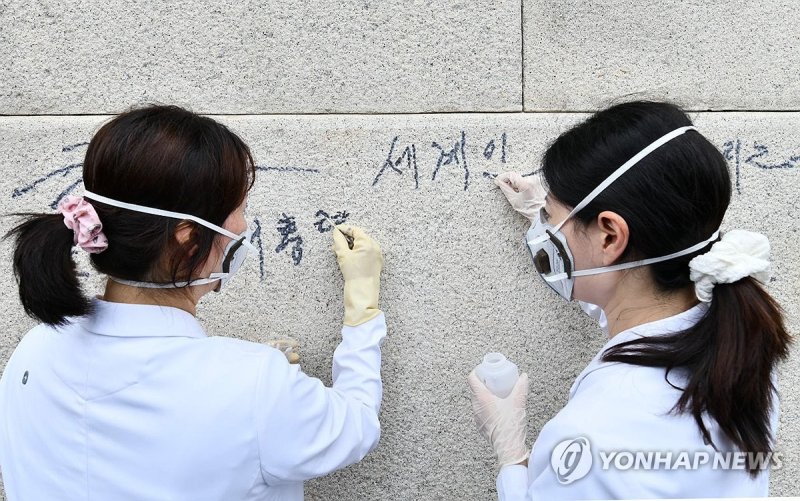
[Financial News] As the incident of graffiti terrorism on the stone wall of Gwanghwamun Gate in Gyeongbokgung Palace has occurred again, attention is focused on the level of punishment. The legal community predicts that heavy criminal punishment and civil damage claims may be filed.
According to the legal community on the 17th, the police arrested Mr. A (79) on the 11th for graffiti on the stone wall of Gwanghwamun Gate in Gyeongbokgung Palace, Jongno-gu, Seoul, using a permanent marker, writing 'Message to the People and the World, President Trump'.
The area of the stone wall damaged by Mr. A is 177cm wide and 31cm high. The police took emergency hospitalization measures as Mr. A made unreasonable statements and needed psychological stability due to his advanced age in his 70s. They also judged that there was a risk of reoffending. As a result of the emergency restoration work by the National Heritage Administration, the graffiti was removed on the day of the incident.
However, regardless of the removal of the graffiti traces, it is expected that severe punishment for Mr. A will be inevitable. The Gyeongbokgung Palace, where the graffiti terrorism occurred, is a state-designated cultural property. Article 92 of the Cultural Heritage Protection Act stipulates that if a state-designated cultural property is damaged, stolen, or concealed, resulting in a loss of utility, it can be punished with more than 3 years of imprisonment. Shin Min-young, a representative lawyer at the law firm Hoam, explained, "According to the Cultural Heritage Protection Act, the possibility of a prison sentence seems high."
Looking at precedents, it is evaluated that a high sentence is expected. In 2023, an incident occurred where high school students graffitied illegal website addresses on the walls of Gyeongbokgung Palace. They were paid 100,000 won by Mr. Kang, who operated an illegal video sharing site, to graffiti on Gyeongbokgung Palace, the National Palace Museum, and the Seoul Metropolitan Police Agency wall. Mr. Lim was sentenced to 2 years long-term and 1 year and 6 months short-term imprisonment in the first trial, and Ms. Kim, who accompanied him to the crime scene, was sentenced to 1 year and 6 months in prison with a 2-year probation. Mr. Kang, who instigated the crime, was recently sentenced to 8 years in prison in the second trial.
In 2009, two people who graffitied with spray on the entrance door of Jeondong Cathedral in Jeonju, Jeollabuk-do, which was privately designated, were sentenced to 2 years in prison with a 3-year probation and 1 year and 6 months in prison with a 2-year probation, respectively. In 2017, a suspect who graffitied with red spray on the private Eonyang Fortress in Ulju-gun, Ulsan, was sentenced to 2 years in prison.
There is also an analysis that Mr. A may be sued for damages by the National Heritage Administration. It is a dominant opinion that various costs such as equipment rental fees, consumable costs, and labor costs involved in the cultural property restoration work can be claimed. Due to the amendment of the relevant law in 2020, it is now possible to claim restoration costs from those who graffiti on cultural properties. The National Heritage Administration also announced a strict response, stating that it can claim the costs necessary for restoration.
Kwak Jun-ho, a lawyer at the law firm Cheong, explained, "Graffiti on Gyeongbokgung Palace, a state-designated cultural property, is very different from graffiti on general buildings in terms of the target and the possibility of recovery, so it can be severely punished." However, he added, "In the case of civil damages, if there is no ability to repay, it is difficult to collect even if the damage amount is recognized."
[email protected] Seo Ji-yoon Reporter