The Disappearing Lunch Hour for Han, 'Where Did He Go?'.. The Shadow of High Inflation
- Input
- 2025-08-17 16:36:38
- Updated
- 2025-08-17 16:36:38
Demand for Solo Dining and Home Meals Increases Due to 'Lunchflation'
Lotte Homeshopping Records Highest Orders for Convenience Meals in July
Lotte Homeshopping Records Highest Orders for Convenience Meals in July
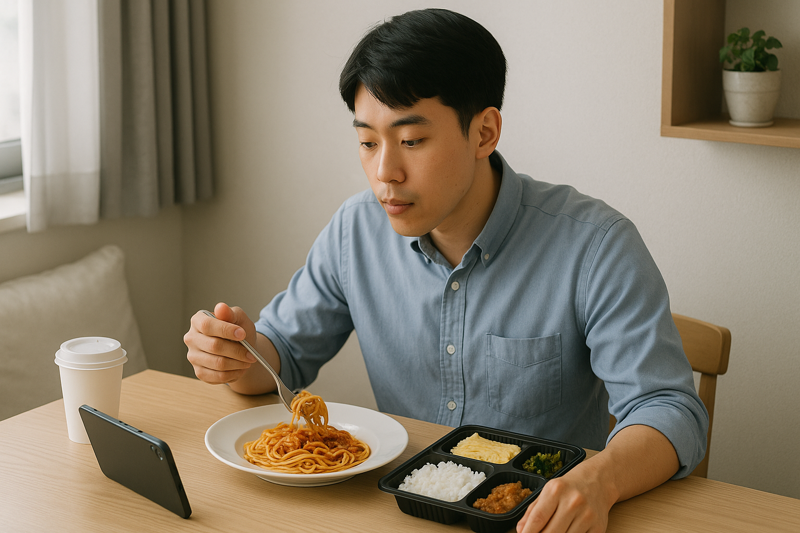
[Financial News] #. "During lunch hours, I usually stop by my studio apartment to have meals mainly consisting of convenience foods like chicken breast salad."
Han, a 20-something office worker, recently started 'solo dining' for lunch after moving into an officetel near his company. Han said, "I feel comfortable eating in my own space while checking social media (SNS), and I can also save on meal expenses."
As high inflation persists and individualism trends, more people are opting for 'solo dining' during lunch instead of eating with colleagues. Despite the domestic market slump, the demand for convenience meals and single servings is surging, leading to rapid growth in related sales.
According to the National Statistical Portal (KOSIS) of Statistics Korea on the 17th, dining out prices in July rose by 3.2% compared to the same month last year, surpassing the overall consumer price increase rate (2.1%) and increasing the burden on ordinary citizens. In fact, as of June, the average price of kimchi stew in Seoul was 8,500 won, up 30.0% from five years ago (6,538 won).
As meal costs rise, a culture of returning home for lunch or bringing packed meals is spreading among office workers. According to Statistics Korea, as of 2024, the rate of eating alone on weekdays is 26.9% for lunch and 25.7% for dinner, up 5.5% and 10.8% respectively from five years ago.
In this atmosphere of solo dining, sales of convenience meals that can replace dining out are steadily increasing. Especially, convenience store lunch boxes and other convenience meals, which can be had for 5,000 to 6,000 won per meal, are attracting demand for 'cost-effectiveness'. CU's lunch box sales in the first half of this year increased by 22.9% compared to the same period last year. GS25 also saw sales of convenience meals such as lunch boxes, gimbap, and sandwiches rise by 14.2% year-on-year, and refrigerated and frozen meal sales increased by 16.1%. Notably, pre-orders for lunch boxes within the application surged by 56.6% compared to the previous year.
The demand for convenience meals is also surging in home shopping, where bulk purchases are possible. Lotte Homeshopping's convenience meal orders in July increased by 30% compared to the same period last year, marking a record high. The prolonged heatwave and the burden of dining out prices were significant factors.
The 'single serving' strategy is essential in the delivery market as well. The 'One Bowl' service introduced by Baedal Minjok at the end of April surpassed 1 million users within 70 days of launch. The removal of the minimum order amount made it easy for individuals to order without burden. Since the expansion of this service, the number of orders has surged. Compared to June, when nationwide service conversion began, the number of orders in July increased by about 94%, and the number of registered menu items increased by about 150%.
An industry official said, "In times of high inflation, there is a strong tendency to emphasize rational consumption," adding, "The trend of expanding demand for convenience meals is likely to continue for the time being."
localplace@fnnews.com Kim Hyunji Reporter