[Exclusive] 3 out of 4 Domestic Violence and Stalking Perpetrators are Male... "Sharp Increase in Juvenile Offenders"
- Input
- 2025-08-13 16:18:43
- Updated
- 2025-08-13 16:18:43
31-fold Increase in Juvenile Stalking Offenders in the Last 3 Years
30% Increase in Domestic Violence
Experts Warn of Habitual Offenders if Early Correction Fails... Urgent Need for Tailored Response
30% Increase in Domestic Violence
Experts Warn of Habitual Offenders if Early Correction Fails... Urgent Need for Tailored Response

[Financial News] #. Teenager A was arrested last month by the police for violating the law on punishment for stalking crimes. From January, he committed stalking by calling and messaging the victim over 100 times for about 5 months, resulting in a restraining order. Despite this, A went to the victim again and was caught by the police who responded to the report.
In the last 3 years, 3 out of 4 perpetrators of domestic violence and stalking crimes were identified as male. The increase in juvenile offenders is notable, with concerns that if moral consciousness is not corrected, they may continue their crimes into adulthood. Experts call for tailored responses according to crime levels, qualitative improvements in the juvenile justice system, and strengthened education.
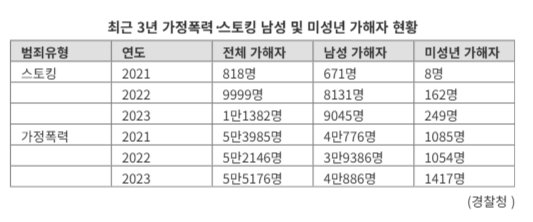
On the 13th, according to 'Annual Statistics on Domestic Violence and Stalking Offenders and Victims by Gender and Age Group' received by Financial News from the National Police Agency through the office of National Assembly member Yoon Gun-young of the Administrative Safety Committee, in the past 3 years (2021~2023), there were 183,506 perpetrators of domestic violence and stalking. Among them, 138,895 were male, accounting for 75.7% of the total.
By age group, the crime rate among middle-aged individuals over 40 was still high. In 2023, the most common age group for domestic violence perpetrators was 41-50 years old, with 15,151 people (27.5%). The same age group also accounted for 2,387 stalking offenders, the second highest proportion (21%) after those under 30 (2,541 people).
Although the proportion of juvenile offenders is low, the increase is significant, highlighting potential risk factors. In the case of stalking, offenders under 19 increased from 8 in 2021 to 162 in 2022, and 249 in 2023, a more than 31-fold increase. Juvenile domestic violence offenders also rose from 1,085 to 1,417 during the same period, an increase of about 30.6%.
Last year, a teenage male student was arrested by the police for attempting to kill a female student with a blunt weapon near a middle school in Sangnok-gu, Ansan City, while she was on her way to school. At that time, the police presumed that the male student committed the crime while stalking the female student.
Experts warn that if juvenile offenders who commit crimes in a state where a healthy sense of reason has collapsed are not managed early, they are at high risk of becoming 'habitual offenders'.
Lawyer Noh Yoon-ho said, "(Nowadays, children) tend to grow up self-centered without considering others' feelings from a young age, so if things don't go their way, they express violent tendencies towards family or loved ones," adding, "If proper correction is not achieved, it could become more serious when they become adults."
There is also advice that it is necessary to not only increase sentences but also to accompany sophisticated responses according to the degree of crime, overall improvement of the juvenile justice system, and substantial education.
Kwak Dae-kyung, a professor at Dongguk University's College of Police and Criminal Justice, said, "While there are children who need soft responses such as counseling or probation to give them a chance to reflect, there are also children who need heavy punishment like adults," adding, "Rather than uniformly strengthening punishment, tailored responses should be conducted by comprehensively considering each individual's growth process, family environment, and school life."
Professor Lee Woong-hyuk of Konkuk University's Department of Police Science emphasized, "We must block elements that act as a waiver due to young age, such as abusing the privileges of the Juvenile Act," adding, "When imposing correctional measures, it is necessary to build a dense infrastructure rather than simply leaving them to guardians after neglect."
Lawyer Noh suggested, "Efforts are needed to analyze the causes of the increase in juvenile offenders through cooperation between government departments such as the Ministry of Gender Equality and Family and the Ministry of the Interior and Safety, and to design tailored education programs that can resolve selfishness."
[email protected] Kim Yeji Reporter