"Will 'Katuktyu' Disappear?" Samsung and POSTECH Solve Challenges for Metasurface Lens Commercialization
- Input
- 2025-08-13 10:27:51
- Updated
- 2025-08-13 10:27:51
Industry-academic collaboration on 'Miniature Eye Camera Metasurface Lens' research paper
Recently published in the world-renowned journal 'Nature Communications'
Recently published in the world-renowned journal 'Nature Communications'
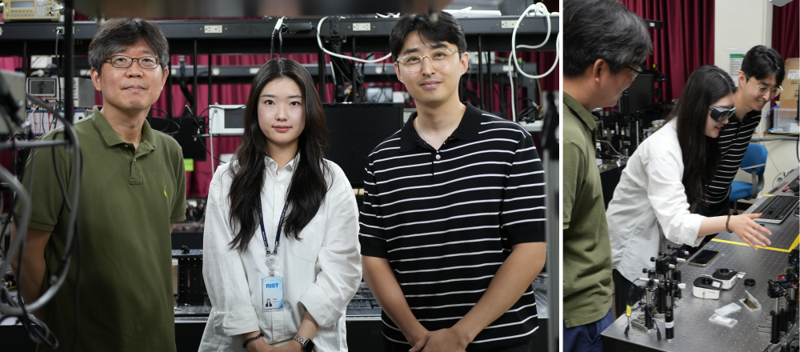
[Financial News] Samsung Electronics announced on the 13th that the research paper on 'Miniature Eye Camera Metasurface Lens' conducted in collaboration with POSTECH has been published in the world-renowned journal 'Nature Communications'. This research was led by Yoon Jung-geun, a researcher at Samsung Research, and Noh Jun-seok, a professor at POSTECH, with Kang Hyun-jung, a researcher at POSTECH, participating as a co-first author. This achievement shows the possibility of reducing the thickness and weight of Extended Reality (XR) devices and lowering the height of smartphone cameras, improving the so-called 'Katuktyu' (the phenomenon where only the camera protrudes from the smartphone).
Metasurface lenses are next-generation optical technology that handles light differently from traditional refractive lenses. By engraving microstructures on a thin substrate to act as a lens, it is advantageous for making much thinner and lighter optical devices.
To create a clear image with metasurface lenses, 'phase delay' that adjusts the wave speed of light is necessary, but it is difficult to produce and prone to breakage, becoming a major obstacle to commercialization. In response, the research team attempted a new design rule that accurately controls light using only the minimum speed control amount. This maintained the same optical performance as before, reduced production difficulty and defect rates, and increased stability. As a result, it became possible to improve yield and secure price competitiveness.
The research team implemented an infrared miniature eye camera for XR devices based on the developed metasurface lens. By applying the metasurface lens, the thickness was reduced by 20% compared to existing refractive lens-based cameras (2.0mm→1.6mm), reducing both weight and volume. It also proved that pupil tracking and iris distinction are possible with the thin thickness.
Samsung Electronics believes that this research is significant as it presents a new design principle for controlling light diffraction, opening up possibilities to reduce the phase delay required for metasurface lens implementation and secure optical performance, mechanical stability, and price competitiveness.
Researcher Yoon explained, "Metasurface lenses had difficulties in applying to commercial products due to high production difficulty and low mechanical stability, but to solve this, we collaborated with experts in each field such as design, simulation, process, and verification to develop a new nano-structure design method." [email protected] Lim Soo-bin Reporter