Korean Medicine Doctors "Korean Medicine Practitioners Should Also Participate in the Medical Workforce Supply and Demand Estimation Committee"
- Input
- 2025-08-12 14:24:08
- Updated
- 2025-08-12 14:24:08
Kim Ji-ho, Vice President of the Korean Medicine Association, Urges Solo Protest at Seoul Station
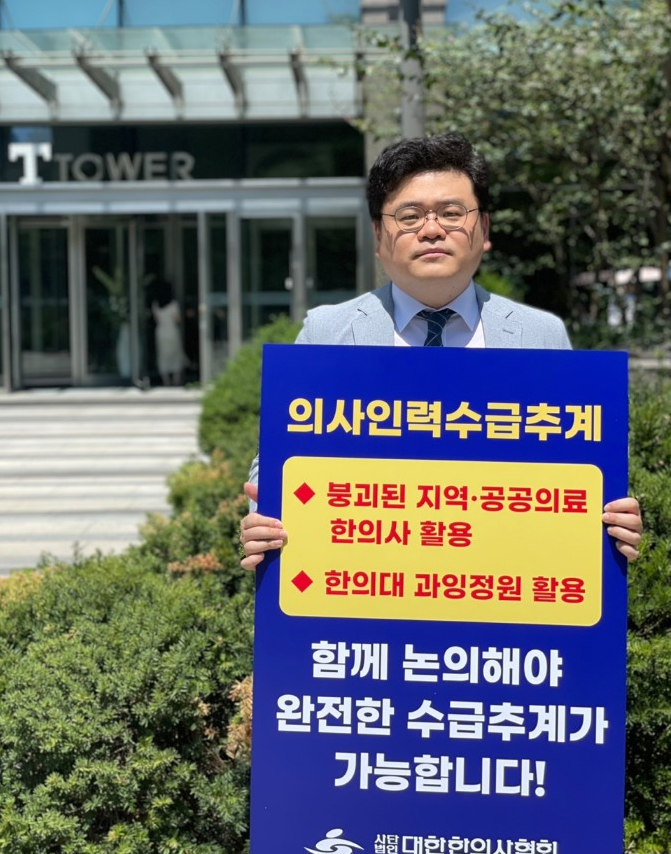
[Financial News] The Korean Medicine Association has demanded that the government ensure the participation of Korean medicine practitioners in the Medical Workforce Supply and Demand Estimation Committee.
The association argued that since the workforce of Korean medicine practitioners and medical doctors mutually influence each other, discussions on workforce supply and demand excluding Korean medicine practitioners could lead to incomplete policies.
Kim Ji-ho, Vice President of the Korean Medicine Association, held a solo protest in front of the Seoul Station T-Tower conference room where the first meeting of the Medical Workforce Supply and Demand Estimation Committee was held at 1 PM on the 12th.
Vice President Kim urged that the utilization of Korean medicine practitioners should also be discussed in this meeting.
The association emphasized that considering the dualized competition and influence between 'Korean medicine' and 'Western medicine' in Korea's healthcare system, the medical workforce supply plan should rationally include the utilization of Korean medicine practitioners in essential regional public healthcare and the utilization of Korean medicine university quotas. In particular, they stated that since there is an expected oversupply of 1,300 to 1,700 Korean medicine university graduates by 2035, it is necessary to appropriately utilize this workforce.
Vice President Kim said, “When OECD countries announce statistics on the number of doctors, they also include Korean medicine practitioners in the Western medical field,” adding, “If only doctors are increased to solve the shortage of essential regional public healthcare personnel, it will take at least 10 years, but if Korean medicine practitioners are deployed after additional training for a certain period, that time can be reduced by more than half.”
He continued, “Deploying trained Korean medicine practitioners in urgent essential regional public healthcare areas will immediately help alleviate the workforce shortage,” adding, “Do not exclude the role of Korean medicine practitioners in discussions on medical workforce supply and demand, and consider the quotas of medical and Korean medicine universities together for a complete estimation.”
[email protected] Kang Jung-mo Reporter