[fn Editorial] Strengthen Cooperation with Vietnam as a Bridgehead for Market Diversification
- Input
- 2025-08-11 19:06:27
- Updated
- 2025-08-11 19:06:27
Korea-Vietnam Summit "Trade to $150 Billion"
Nuclear Power, High-Speed Rail, etc. Korean Companies Expected to Participate
Nuclear Power, High-Speed Rail, etc. Korean Companies Expected to Participate
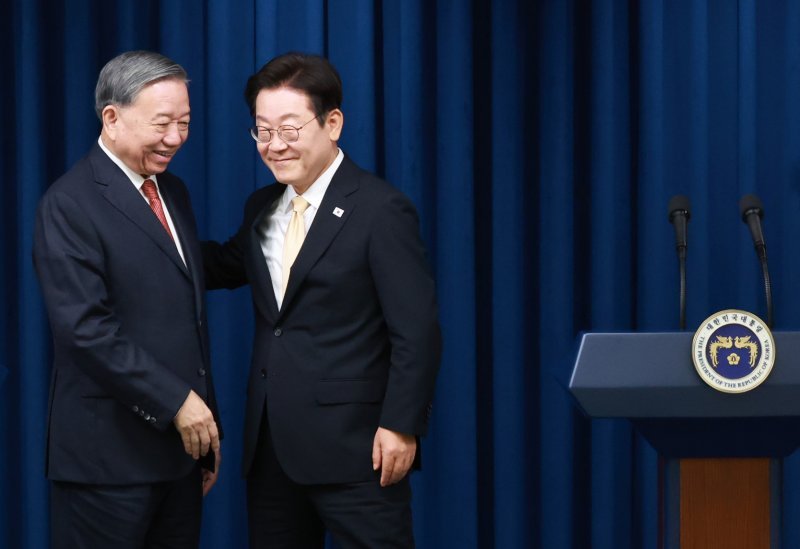
The trade volume between Korea and Vietnam is expected to grow to $150 billion by 2030. Currently, it is about $100 billion, which is not small, but it is seen as an achievable goal if the friendly relations between the two countries continue. President Lee Jae-myung announced various cooperation plans between the two countries after holding a summit with To Lam, the General Secretary of the Communist Party of Vietnam, who visited Korea as a state guest on the 11th. He stated that they would accelerate cooperation in large-scale infrastructure fields such as defense, public safety, nuclear power, high-speed rail, and new city development.
The value of the Vietnamese market is exceptional in the rapidly changing global supply chain. Above all, Vietnam is the fastest-growing country in Asia, with a dynamic population structure where the young population is predominant. The average age of its 100 million population is 32. The working-age population accounts for 67% of the total population. The growth trend remains strong even amidst a trade war with the United States. Vietnam's growth rate in the first half of this year was 7.52%, the highest in the past 15 years. The annual growth rate forecast for this year is in the 8% range. The market's vitality is palpable.
The relationship with Korea has painful memories of once pointing guns at each other in a war zone, but now Vietnam has become a key trading partner, ranking as the third-largest trading country after China and the United States. Vietnam overtook Japan in 2022 to become the third-largest trading country and has maintained this position ever since. In 2022, it surpassed the United States to become the largest trade surplus country, and since then, it has firmly held the position of the second-largest surplus country. President Lee's remark after the summit that "Vietnam is a very important neighboring country to Korea" is in this context. The fact that To Lam is the first state guest of the new government is also noteworthy.
The synergy between Korean and Vietnamese companies has exceeded expectations. Since establishing formal diplomatic relations in December 1992, the two countries have steadily expanded the scale of economic cooperation. Major Korean companies such as Samsung, Hyundai, and LG have been competing to make large-scale investments. In 2014, the Korea-Vietnam Free Trade Agreement (FTA) was signed. The trade volume between the two countries has grown 150 times since the establishment of diplomatic relations and 2.5 times since the FTA. The number of Korean companies entering Vietnam surpassed 10,000 last year, and the jobs they created locally exceed 1 million.
The fields where companies from both countries can join hands in the future are limitless. We hope that Korean companies will seize opportunities in major national projects such as the new nuclear power plant construction, north-south high-speed rail construction, and new city development in Vietnam, as mentioned by President Lee. The Memorandum of Understanding (MOU) signed on the day for human resource development in the nuclear power sector can serve as a good foundation for nuclear cooperation. If Korean companies participate in the development of the Dong Nam New City in Bac Ninh Province, Vietnam, it will be a significant achievement as the first export of K-New City. Cooperation in advanced fields such as artificial intelligence, biotechnology, energy, and core minerals like rare earths is also an important issue for both countries. Diplomatic and policy support from the government must continue.
In the midst of a rapidly changing market with a new trade order, diversifying export markets and investments is not a choice but a necessity. It is essential to reduce dependence on China to overcome the China risk, and it is inevitable to redefine trade relations with existing allies such as the United States. Finding new opportunities in Vietnam and using it as a bridgehead to accelerate the development of new markets and businesses across the ASEAN region is possible. It is a necessary task not only from an economic perspective but also from a security standpoint. We hope that the government and the private sector will work together to achieve concrete results in Vietnam and the southern market.