"Steel also captures carbon"... Hyundai Steel, Asia's first CCUS hub exploration
- Input
- 2025-08-11 14:52:31
- Updated
- 2025-08-11 14:52:31
Consortium with 5 global companies including BHP and Chevron
Review of candidate sites in Southeast Asia and northern Australia
Review of candidate sites in Southeast Asia and northern Australia
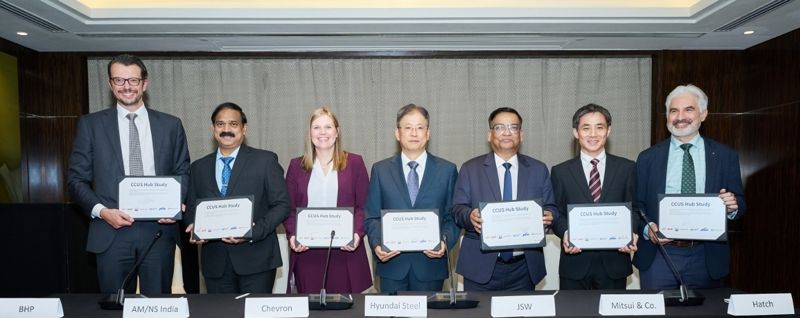
[Financial News] Hyundai Steel is joining hands with global steelmakers, energy companies, and trading companies to conduct joint research to explore a carbon capture, utilization, and storage (CCUS) hub. This is the first time the Asian industry is leading a CCUS research project.
Hyundai Steel announced on the 11th that it signed a joint research agreement for the 'CCUS Hub Study' in Singapore on the 7th (local time) by forming a consortium with five companies including BHP of Australia, Chevron, Mitsui & Co. of Japan, JSW Steel of India, and AM/NS India (a joint venture of ArcelorMittal and Nippon Steel).
The goal of this project is to discover a key base that compresses and processes carbon dioxide generated from various industrial facilities. Global engineering company Hatch will be in charge of operations, and the collected carbon dioxide will be transported to an offshore storage facility for underground storage.
The participating companies plan to select hub candidates and review construction and commercialization possibilities in Southeast Asia and northern Australia over the next 18 months.
Hyundai Steel expects to strengthen its global network in the CCUS field through this agreement and add a key strategy to the carbon neutrality roadmap of the steel industry.
A Hyundai Steel official said, "This consortium is an opportunity to develop various carbon reduction technologies including CCUS and expand the possibility of carbon neutrality," adding, "Collaboration with global companies will contribute to strengthening the sustainability of the steel industry."
Meanwhile, Hyundai Steel has been reviewing reduction measures through connections with overseas industries along with its own carbon dioxide reduction efforts as a major means to achieve carbon neutrality by 2050. [email protected] Lee Dong-hyuk Reporter