"Recruiting Newcomers Like Experienced" Is Even the Opportunity to Challenge Disappearing?
- Input
- 2025-08-12 06:00:00
- Updated
- 2025-08-12 06:00:00
Survey by Saramin... New Recruitment at 67.7%, Down 16%p Compared to First Half
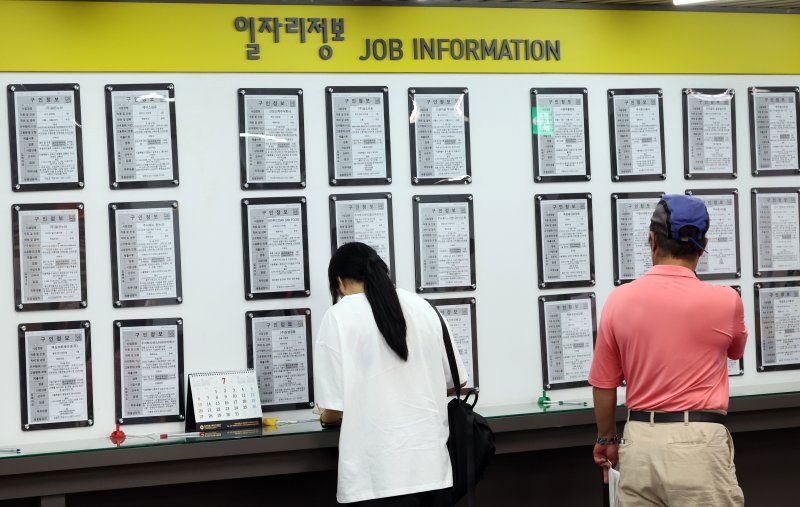
[Financial News] It has been surveyed that 6 out of 10 companies plan to hire regular employees in the second half of the year. However, the proportion of new hires has decreased compared to the first half.
According to the career platform Saramin on the 11th, 58.5% of 371 companies answered that they have plans for regular recruitment in the second half. Companies without recruitment plans were 27.5%, and undecided were 14%.
By company size, '100 to less than 300 employees' was the highest at 73%, followed by 'less than 100 employees' at 57%, and '300 or more employees' at 55.2%.
Among companies hiring regular employees, 58.5% said they would hire both new and experienced employees. Companies hiring only experienced employees were 32.3%, and those hiring only new employees were 9.2%. The proportion of new hires was 67.7%, a decrease of 16 percentage points (p) compared to the first half of this year (83.6%). The proportion of experienced hires was 90.8%, similar to the first half (91.9%).
The main reason for hiring regular employees was 'lack of manpower' at 58.1% (multiple responses), followed by 'planned resignation' (28.1%), 'securing excellent manpower' (24%), and 'business expansion' (18.9%).
The method of hiring new employees was 'only using occasional recruitment' at 59.2%, 'combining open and occasional recruitment' at 34%, and 'only using open recruitment' at 6.8%. The starting salary was an average of 32.98 million won, with 31.3% being between 30 million and less than 35 million won.
For hiring experienced employees, 77.2% (multiple responses) said they use occasional and regular recruitment. This was followed by experienced public recruitment (25.9%), talent search on recruitment platforms (12.2%), internal recommendations (10.7%), and headhunter utilization (7.1%). The expected years of experience for recruitment were 3 years (30.5%), 5 years (23.4%), 2 years (16.2%), and 1 year (13.7%), with juniors of 3 years or less accounting for 60.4%.
A Saramin representative said, "In the second half, the demand to replenish insufficient manpower is predominant, while some companies are making preemptive investments in excellent talent or expanding their business," and "We are monitoring changes in recruitment demand according to job and industry economic fluctuations."
On the other hand, companies without recruitment plans cited 'sufficient with current manpower' (42.9%), 'poor business conditions' (33.1%), 'burden of labor costs' (30.5%), and 'domestic and international uncertainties' (27.3%) as reasons.
[email protected] Shin Ji-min Reporter