Criteria for the Second Consumption Coupon Distribution to be Revealed Next Month... Ministry of the Interior and Safety, Full-Scale Preparation of Distribution Criteria
- Input
- 2025-08-10 14:05:56
- Updated
- 2025-08-10 14:05:56
10 KRW per person for 90% of the population... Deliberation on handling high-asset individuals
[Financial News] 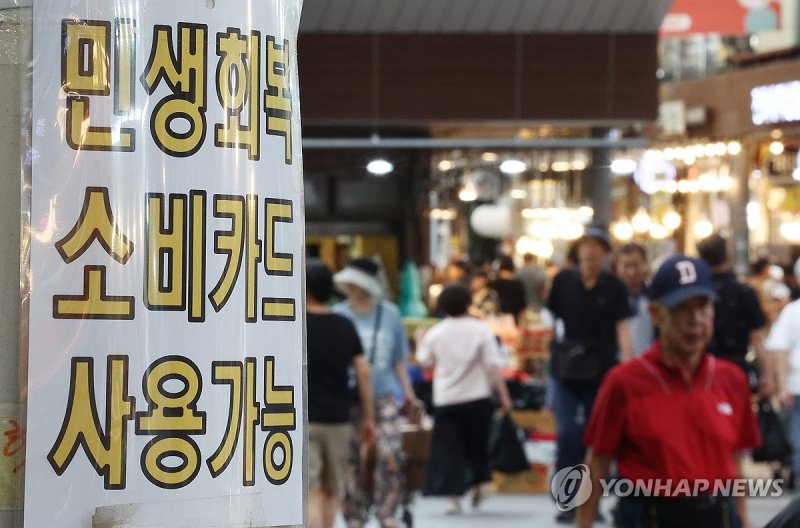
The government is set to fully prepare the criteria for the distribution of the second livelihood recovery consumption coupon, which will start on September 22.
The second consumption coupon will be distributed to about 90% of the population based on health insurance premiums, with 100,000 KRW per person, and the key issue is how to exclude the top 10%.
On the 10th, the Ministry of the Interior and Safety announced that it plans to focus on discussions with the Ministry of Health and Welfare and the National Health Insurance Corporation from around the 18th on the criteria for excluding high-asset individuals, the application of special cases for single-person households and dual-income households, and to finalize the criteria by the 10th of next month.
However, in this process, the government plans to establish criteria on how to filter out cases where multiple high-priced apartments are owned.
The COVID-19 coexistence national support fund was basically targeted at households with income below the bottom 80%, but special criteria were applied to single-person and dual-income households, resulting in about 88% of households receiving the support fund.
At that time, single-person households were eligible for support if their health insurance premiums were 170,000 KRW or less, regardless of whether they were workplace or regional subscribers. This amount corresponds to an annual income of about 58 million KRW for workplace subscribers, and the income criteria were relaxed considering the high number of elderly or economically inactive people.
For dual-income households, a criterion that added one more person to the number of household members was applied, as they could relatively suffer disadvantages due to higher income than single-income households. For example, a two-person dual-income household was subject to the same health insurance premium criteria as a three-person household.
Additionally, high-asset individuals and the health insurance premium payment period are also variables.
Health insurance premiums apply to both workplace and regional subscribers, but there is a difference in the calculation method.
For workplace subscribers, premiums are calculated based only on income such as salary, and the company bears half of the cost. In contrast, for regional subscribers, premiums are calculated by adding up not only income but also owned assets, and the individual bears the entire cost.
Due to this, the level of health insurance premiums can vary depending on the household type or subscription type, and there can be differences in eligibility for benefits even at the same income level.
During the 2021 coexistence national support fund distribution, even if the health insurance premium criteria were met, those whose total standard amount of property tax exceeded 900 million KRW or whose financial income exceeded 20 million KRW were excluded from the distribution.
At that time, only the health insurance premiums for the month of June were used as the criteria, causing issues where middle and lower-class workers with irregular income, such as day laborers and temporary workers, were excluded from the target.
This time, there is also a call for supplementary measures to prevent such equity issues from recurring.
[email protected] Kim Taekyung Reporter