Jogpaecheon 'Korean' Son Gijeong... Pride Soars Following His Steps [Weekend Culture]
- Input
- 2025-08-08 04:00:00
- Updated
- 2025-08-08 04:00:00
National Museum 'Conquering the World on Two Feet' Exhibition
First Public Display of Son Gijeong's Olympic Victory Signed Postcard
"Historical Material Revealing Korean Identity"
The Ancient Greek 'Bronze Helmet' Also Catches the Eye
"Time to Reflect on His Passionate Will and Belief"
First Public Display of Son Gijeong's Olympic Victory Signed Postcard
"Historical Material Revealing Korean Identity"
The Ancient Greek 'Bronze Helmet' Also Catches the Eye
"Time to Reflect on His Passionate Will and Belief"
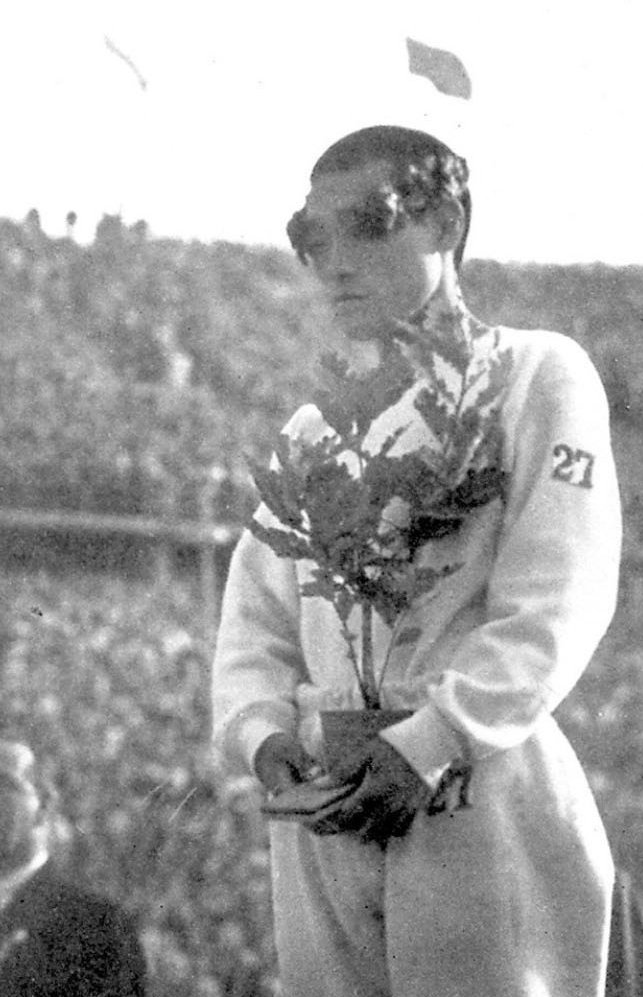
August 9, 1936, the main stadium of the Berlin Olympics in Germany. The audience filled the venue, cheering for the athlete running vigorously. The final record for the 42.195 km run was 2 hours 29 minutes and 19 seconds. It was a new record that broke the so-called '30-minute wall' in both the Olympics and international competitions at the time.
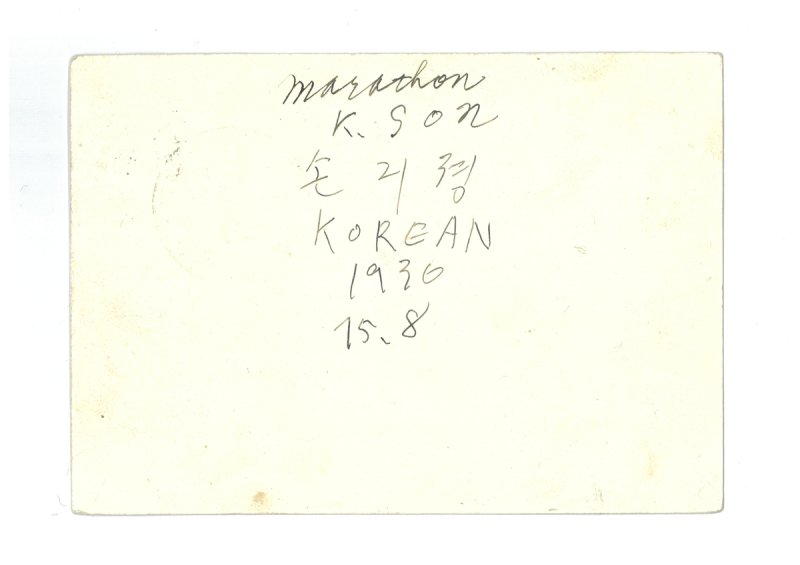
However, the expression of Son Gijeong (1912-2002) standing on the podium was full of anxiety. There was a Japanese flag on his chest, and the Japanese national anthem, Kimigayo, was played. Domestic media reported the news with photos that erased or blurred the Japanese flag. The so-called 'Japanese flag erasure incident' caused a worldwide stir, but a few days later, Son left a signature on a small postcard as 'Korean Son Gijeong'.
After winning the Berlin Olympics, his biggest concern while meeting numerous congratulators was 'how to let people know that I am not Japanese but Korean'. Although he often got into trouble, he made sure to draw a map of Korea alongside his Hangul signature 'Son Gijeong' or indicate his nationality with the English letters 'KOREA'.
A special exhibition highlighting his footsteps, including the first public display of the postcard he signed directly on August 15, 1936, after winning the Berlin Olympics, will be held in Yongsan, Seoul. The National Museum of Korea is holding the special exhibition 'Conquering the World on Two Feet' in Commemoration Room 1 of the Permanent Exhibition Hall until December 28, marking the 80th anniversary of liberation.
The exhibition title 'Conquering the World on Two Feet' is derived from the calligraphy 'Jogpaecheon' written by Baekbeom Kim Gu (1876-1949) to celebrate the Boston Marathon victory of Son's disciple Seo Yunbok (1923-2017) in 1947. This exhibition features 18 items showing his journey, including the first public display of Son's signed postcard, the 1936 Berlin Olympic gold medal and laurel crown, the winner's certificate, the ancient Greek bronze helmet (Treasure No. 904), and related newspaper articles.
Additionally, visitors can experience video content recreated with artificial intelligence (AI) technology. It vividly conveys the emotions of the day, from young Son, who had to run with the Japanese flag in 1936, to his disciples who reached the top of the world under the name 'KOREA' in 1947 and 1950, and Son in his later years as a torchbearer for the 1988 Seoul Olympics.
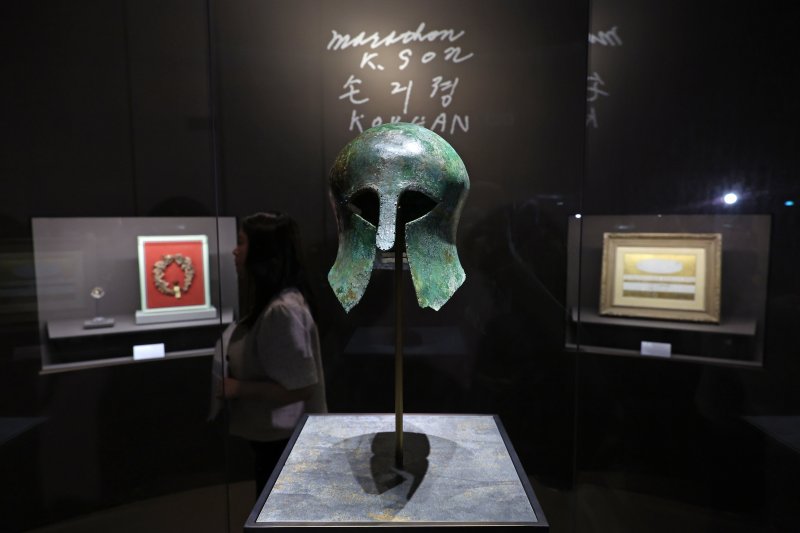
The exhibition is centered around the treasure 'Ancient Greek Bronze Helmet' donated by Son. Initially, the 'Bronze Helmet' was supposed to be awarded to the marathon winner of the Berlin Olympics, but it was not delivered to Son and was kept at the Charlottenburg Museum in Berlin after World War II.
After long efforts for its return, it was returned to him at the 50th-anniversary event of the Berlin Olympics in 1986 and was designated as a treasure the following year.
The 'Bronze Helmet' he received belatedly was made in Corinth, Greece, in the 6th century BC. It was created for the purpose of offering to the gods while wishing for victory during the Olympic Games. Its mysterious turquoise color and gracefully flowing shape are remarkable.
Son, who received the 'Bronze Helmet' back after 50 years, said, "This helmet is not just mine, but belongs to our people," and donated it to the National Museum of Korea in 1994.
Among the various exhibits, his first publicly displayed signed postcard holds great historical value. It is said that Son signed 'Son Gijeong' in Hangul whenever he had the opportunity to let people know he was Korean, not Japanese. The National Museum of Korea evaluated the postcard as "an important material showing the strong will to reveal Korean identity."
Additionally, the New York Times newspaper, which reported his Berlin Olympic marathon victory on August 10, 1936, is also being shown for the first time. It is particularly interesting as the article mentions that Son is of Korean origin.
"The 120-pound youth from Korea finally reached the finish line after a grueling 26-mile journey. Before him lay only the red dirt road towards the crown of crowns of the Olympics. His face showed no sign of tension or pain, and his expression was as if it were a marble mask. He only looked ahead and ran, and even the tremendous cheers of the audience could not shake him."
The National Museum of Korea emphasized about this exhibition, "We hope to reflect on Son's passionate will and belief by following his footsteps, which conveyed hope and courage despite the difficult times."
rsunjun@fnnews.com Yuseonjun Reporter