Is the effect of June 27 waning? Seoul apartment prices increase after 6 weeks
- Input
- 2025-08-07 14:00:00
- Updated
- 2025-08-07 14:00:00
Increase in 16 areas including Seongdong and Gwangjin
Price increase continues amid transaction stagnation
Price increase continues amid transaction stagnation
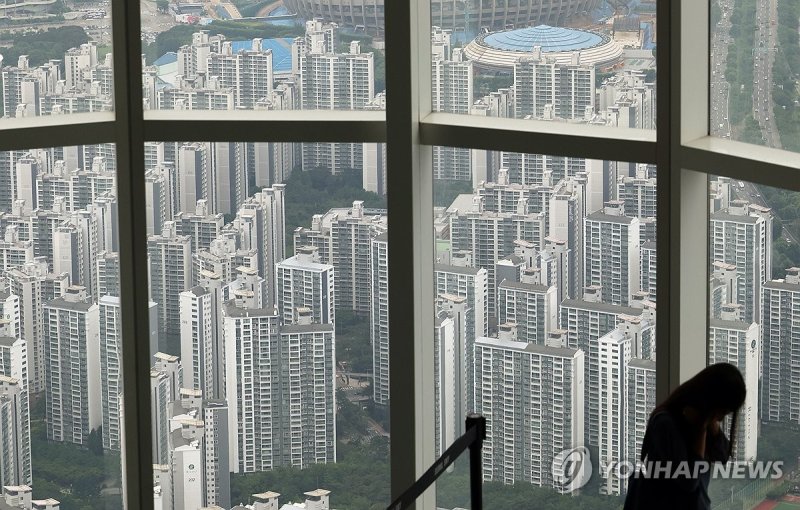
[Financial News] The increase in Seoul apartment prices has expanded again after 6 weeks. The Seoul housing market, which had been showing a slowdown since the June 27 loan regulations, has increased again after 6 weeks. Most districts have seen an increase or maintained their growth, while only a few areas have slightly slowed, showing mixed trends.
■Increase in 16 out of 25 districts
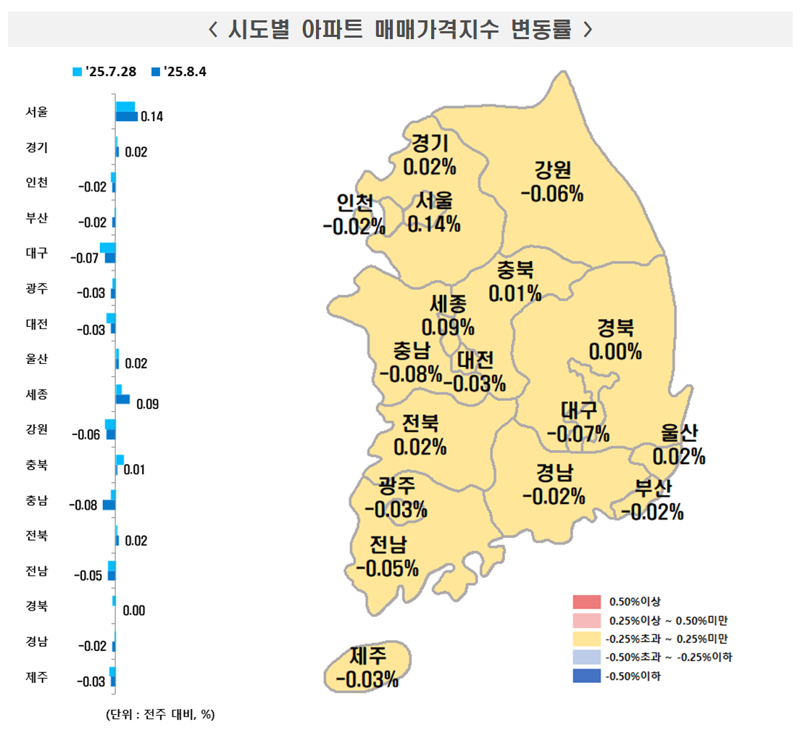
According to the 'Weekly Apartment Price Trend for the First Week of August 2025 (as of August 4)' announced by the Korea Real Estate Board on the 7th, Seoul apartment prices rose by 0.14%, which is 0.02%p higher than the previous week (0.12%). The increase is the largest since June 23 (0.43%) after 6 weeks.
The number of districts with increased growth reached 16. Seongdong-gu increased from 0.22% to 0.33%, and Gwangjin-gu from 0.17% to 0.24%, with increases of 0.11%p and 0.07%p respectively. Also, Gangnam-gu increased from 0.11% to 0.15%, Yongsan-gu from 0.17% to 0.22%, and Mapo-gu from 0.11% to 0.14%.
In the northeastern region, the increase was seen in five areas: △Dongdaemun (0.07%→0.08%) △Dobong (0.04%→0.06%) △Seongbuk (0.04%→0.06%) △Gangbuk (0.03%→0.04%) △Jungnang (0.02%→0.04%). In the northwestern region, △Seodaemun (0.07%→0.09%) △Eunpyeong (0.04%→0.06%), in the southwestern region △Yangcheon (0.17%→0.18%) △Guro (0.08%→0.10%) △Geumcheon (0.04%→0.06%), and in the southeastern region △Gangdong (0.07%→0.14%) saw increased growth.
In terms of growth rate, Songpa-gu (0.38%) ranked first. It was followed by Seongdong-gu (0.33%), Gwangjin-gu (0.24%), Yongsan-gu (0.22%), Yangcheon-gu (0.18%), Seocho-gu (0.16%), Gangnam-gu (0.15%), and Mapo-gu (0.14%).
■Signal of weakening regulation effect "Needs to be watched"
Only 5 districts showed a slowdown in growth. Songpa-gu decreased from 0.41% last week to 0.38% this week, Seocho-gu from 0.21% to 0.16%, and Dongjak-gu (0.11%→0.09%), Gwanak-gu (0.10%→0.08%), Jongno-gu (0.07%→0.06%) also slightly slowed.
The overall apartment prices in the metropolitan area also rose by 0.05%, expanding from the previous week's 0.04%. Gyeonggi apartment prices increased from 0.01% to 0.02%, and Incheon saw a reduction in the decline from -0.03% to -0.02%. In Gyeonggi, the increase was seen in Gwacheon (0.29%→0.34%), Seongnam (0.18%→0.36%), and Hanam (0.02%→0.17%), while Pyeongtaek saw an expanded decline from -0.17% to -0.32%.
Meanwhile, experts believe this rebound could be a signal that the effect of loan regulations is weakening.
Meanwhile, experts believe this rebound could be a signal that the effect of loan regulations is weakening.
Lee Eun-hyung, a researcher at the Korea Construction Policy Research Institute, pointed out, "The government tried to curb house prices through loan regulations, but demand has flowed into redevelopment complexes or preferred areas, leading to a price rebound," adding, "The policy effect is not being fully reflected in the market as expected."
On the other hand, there is a view that it remains to be seen whether the price increase will spread to the entire market. Park Won-gap, a senior expert at KB Kookmin Bank, diagnosed, "It is uncertain whether the rebound trend seen in redevelopment and other areas will lead to a recovery of the entire market," adding, "It is difficult to hastily conclude that house prices will continue to rise in a situation where transaction volume is not sufficiently supported."
[email protected] Jang In-seo Reporter