10.01 Million Elderly People to Work... "Want to Work Until 73.4 Years Old"
- Input
- 2025-08-06 12:45:14
- Updated
- 2025-08-06 12:45:14
Average Monthly Pension 860,000 Won... 70s Also to Work
Employment Rate 59.5%, 9.78 Million Employed
Simple Labor and Service Jobs Still Predominate
Slight Increase in Office and Professional Jobs
1.142 Million Also Hope to Work in the Future
[Financial News] Employment Rate 59.5%, 9.78 Million Employed
Simple Labor and Service Jobs Still Predominate
Slight Increase in Office and Professional Jobs
1.142 Million Also Hope to Work in the Future
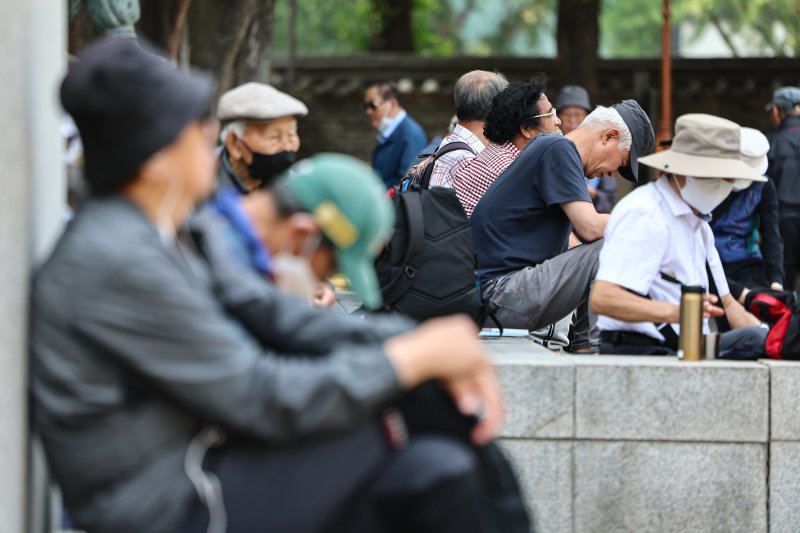
The number of elderly people aged 55 to 79 who are working or seeking jobs is 10.01 million, surpassing 10 million for the first time. This shows that 'working seniors' are becoming a norm amid aging and increased life expectancy.
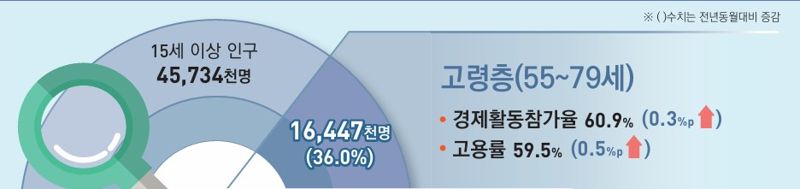
According to the 'May 2025 Elderly Supplementary Survey' released by Statistics Korea on the 6th, the population of elderly people aged 55 to 79 was 16.447 million, an increase of 464,000 from the same month last year. This accounts for 36% of the total population aged 15 and over.
The labor force participation rate of the elderly was 60.9%, up 0.3 percentage points from the same period last year. The actual number of employed people reached 9.78 million, approaching the '10 million era'.
The unemployment rate fell by 0.2 percentage points to 2.3%, indicating that a significant number of elderly people who want jobs are successfully getting employed. The number of employed increased by 344,000, and the number of unemployed decreased by 16,000.
Both the labor force participation rate (60.9%) and the employment rate (59.5%) for those aged 55 to 79 continued to rise. This means that 6 out of 10 elderly people are still in the labor market.
By age group, the employment rate for those aged 55 to 64 rose by 0.6 percentage points to 71.1% over the year, and the employment rate for those aged 65 to 79 increased by 0.9 percentage points to 47.2%.
Looking at the occupational distribution of employed elderly people, the proportion of simple labor workers (22.6%) and service workers (14.5%) is high, while the proportion of managers (2.1%) and office workers (8.3%) is low. However, the proportion of office workers increased by 0.9 percentage points, and professionals and related workers increased by 0.7 percentage points compared to the same month last year, while skilled agricultural, forestry, and fishery workers decreased by 1.1 percentage points, and simple labor workers decreased by 1.0 percentage points.
The expansion of economic activity among the elderly is due to the reality that living solely on pensions is difficult. Half of the elderly (51.7%, 8.502 million) receive pensions, but the average monthly amount is only 860,000 won (a 5.0% increase from the same month last year). It is insufficient to cover living and medical expenses with just the pension.
In fact, 69.4% (11.421 million) responded that they 'want to work in the future'. The desired working age is 73.4 years, and it is increasing every year.
In the past year, 20.0% of the elderly had job-seeking experience (a 0.7 percentage point decrease from the same month last year). The main channels used for job searching were public institutions such as the Ministry of Employment and Labor (38.2%) and introductions from friends and acquaintances (29.9%).
The employment experience rate was 67.3%, up 0.1 percentage points. Among those with employment experience, 8 out of 10 (85.4%) responded that they 'got employed only once'.
As for job selection criteria, both men and women considered 'amount of work and time' (men 23.9%, women 37.7%) as the most important. The desired wage was highest in the '300,000 won or more' range for men (33.0%) and the '100,000 to 150,000 won' range for women (21.1%).
[email protected] Lee Bomi Reporter