Democratic Party "K-Steel Law Party Initiative"... Ruling Party to Save Steel with '50% Tariff Bomb'
- Input
- 2025-08-06 11:16:34
- Updated
- 2025-08-06 11:16:34
Steel Industry Support Law Proposed by 106 Members of Ruling and Opposition Parties
Democratic Party Initiative, Bill Processing Expected to Accelerate
Democratic Party Initiative, Bill Processing Expected to Accelerate
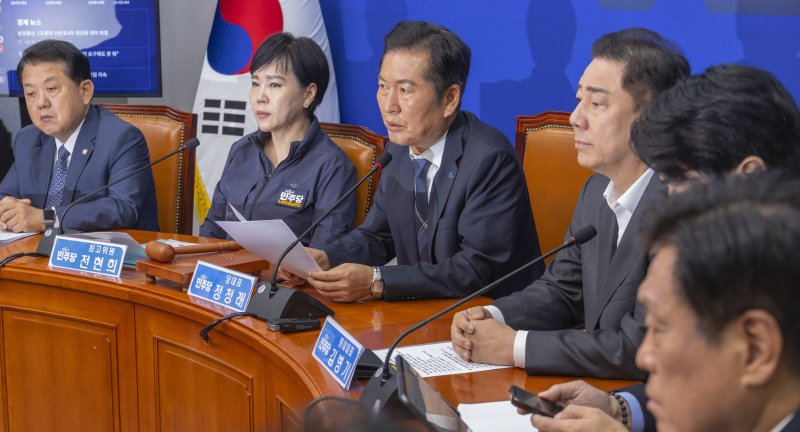
[Financial News] The Democratic Party has decided to pursue the 'K-Steel Law' (Special Act for Strengthening Steel Industry Competitiveness and Transition to Green Steel Technology), proposed by 106 ruling and opposition lawmakers on the 4th, as a party initiative to support the steel industry struggling with the United States' 50% high tariffs. With an unusual participation of 106 ruling and opposition lawmakers in the bill proposal and the ruling party announcing its initiative, the bill processing is expected to accelerate.
Gwon Hyang-yeop, spokesperson for the Democratic Party, met with reporters after the Supreme Council meeting at the main building of the National Assembly in Yeouido, Seoul, on the 6th and said, "We have decided to pursue the K-Steel Law proposed by 106 ruling and opposition lawmakers on the 4th as a Democratic Party initiative," adding, "(Our steel industry) is struggling due to the 50% tariff imposed by the United States on steel."
The K-Steel Law aims to establish a 'Special Committee for Strengthening Steel Industry Competitiveness' chaired by the President to formulate a basic plan every five years and an annual implementation plan. It also designates decarbonization steel technologies like hydrogen reduction steelmaking as 'green steel technology' and specifies subsidies, loans, tax reductions, and production cost support for technology development and investment.
Additionally, it plans to create a green steel special zone to simplify licensing procedures, exempt preliminary feasibility studies, provide tax support, and support infrastructure installation, along with regulatory-related special cases and financial support. It also includes strengthening origin regulations, restricting the import and distribution of non-compliant steel materials, and granting the government direct response authority to unfair trade practices. Moreover, it prepares a systematic nurturing plan for related industries to secure competitiveness in eco-friendly steel raw materials.
Furthermore, if voluntary industrial restructuring by steel companies and supply-demand control of steel is not possible, the government will actively induce business restructuring and supply-demand control through tax and financial support to secure new demand.
This bill was initiated by the National Assembly to support legislation as concerns grew after the Korea-U.S. tariff negotiations were concluded, but the 50% tariff on steel remained unchanged. In the Korea-U.S. tariff negotiations concluded on July 31 (local time), the 50% tariff rate on steel, copper, and aluminum remained unchanged. The steel industry, which was subject to a 50% high tariff, is bewildered as the tariff is confirmed as it is. The steel industry is expressing difficulties, saying that if the duty-free quota for exports to the U.S. is abolished, the tariff will soar from 0% to 50%, effectively blocking the export route to the U.S.
[email protected] Choi Jong-geun, Kim Yun-ho Reporter