'Muslim Consumers Avoid It'.. What is the 'Packaging Label' Regulation Hindering the Globalization of K-Food
- Input
- 2025-08-05 15:31:45
- Updated
- 2025-08-05 15:31:45
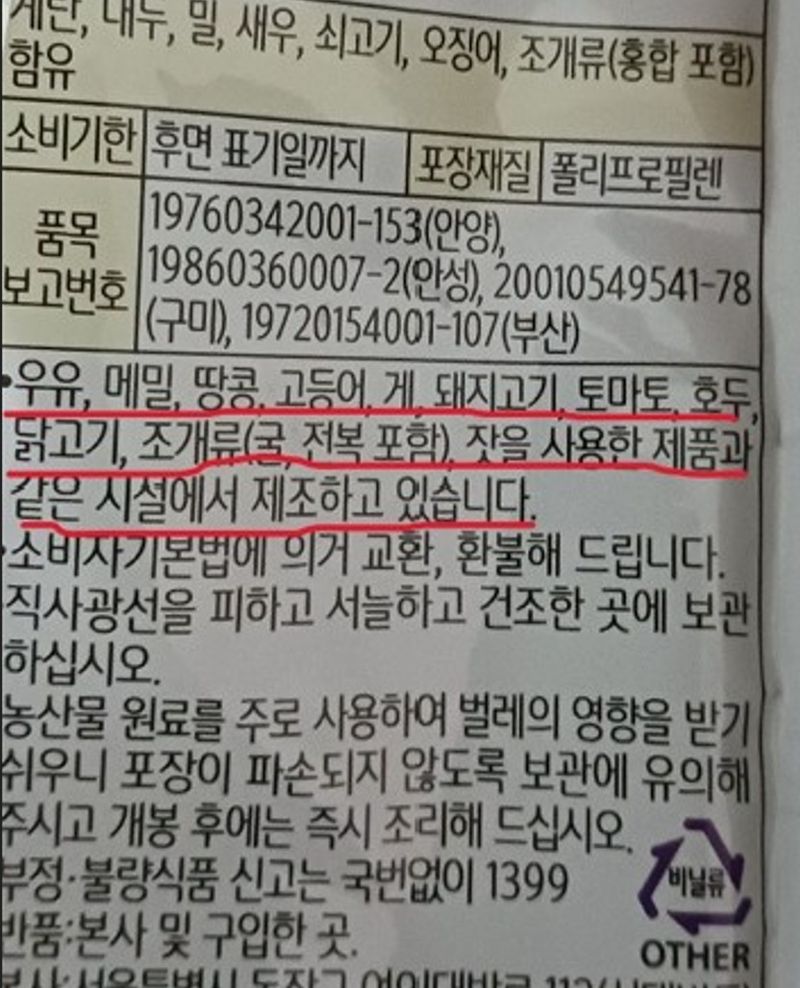
[Financial News] As the era of 1 million Muslim tourists visiting Korea has arrived, there is criticism that the mandatory 'allergy ingredient inclusion label' on packaging of processed foods such as ramen distributed domestically is hindering the globalization of K-food. Even if pork or beef ingredients are not actually included in the product, if it is produced in the same factory as products containing allergy ingredients, a warning label must be displayed, making it a 'product to avoid' for Muslim and Hindu consumers.
According to the industry on the 5th, it has recently become popular among overseas Muslim consumers to use image-based artificial intelligence (AI) apps to check product labels to determine whether food contains pork.
It is said that they use AI, translators, etc. to check the halal logo, ingredient list, and allergy labels. When the label is photographed with a smartphone camera, the AI recognizes the text and translates it or highlights phrases related to pork. Muslims do not eat pork according to Sharia law.
The problem is that the warning label about the inclusion of allergy-causing ingredients, which is based on domestic law and unrelated to actual ingredients, causes confusion among Muslim consumers.
Korea Agro-Fisheries & Food Trade Corporation (aT) pointed out in its report on Middle East non-tariff barrier issues that "Muslim consumers tend to avoid purchasing products solely based on the presence of the word 'pork' in the warning label, regardless of the actual ingredients." It added, "Even if there is no direct relation to the ingredients or if the word 'pork' is merely mentioned in the allergy label, consumers may avoid purchasing the product if they perceive it as containing pork."
This is due to the 'Regulations on Labeling and Advertising of Foods, etc.' which mandates the inclusion of a warning label about the inclusion of allergy ingredients on all processed food packaging distributed domestically.
The regulation requires that even if allergy-causing ingredients are not directly included in the food, if it is produced through the same manufacturing process (workers, equipment, production line, etc.) as products using allergy-causing ingredients, a 'risk of inclusion' warning must be displayed. For example, it may be labeled as "This product is manufactured in the same facility as products using pork, which may cause allergies" or "Possibility of pork inclusion."
Korea designates 19 types, including pork and beef, as allergy-causing ingredients.
The responsible government agency, the Ministry of Food and Drug Safety, maintains that the regulation only applies domestically. A representative from the Ministry stated, "Export products are not subject to the Food Labeling and Advertising Act for allergy labeling, etc., and must comply with the relevant laws of the importing country," explaining that "the exporting company must label according to the allergy-related standards of the importing country."
However, as the number of Muslim tourists visiting Korea surpasses 1 million annually for the first time, and interest in K-food surges, voices calling for regulatory improvement are emerging, particularly in the food industry. In fact, according to the Korea Tourism Organization, the estimated number of Muslim tourists visiting Korea last year reached 1,037,438.
An aT representative stated, "If elements like pork, which Muslim consumers may be sensitive to, are not included, it is necessary to improve so that such information is not labeled on the product packaging."
ssuccu@fnnews.com Kim Seoyeon Reporter