Only Looking at Cars 'FTA Useless Theory?' Minister Kim Jeong-gwan "Ramen Still Benefits from FTA"
- Input
- 2025-08-05 09:04:23
- Updated
- 2025-08-05 09:04:23
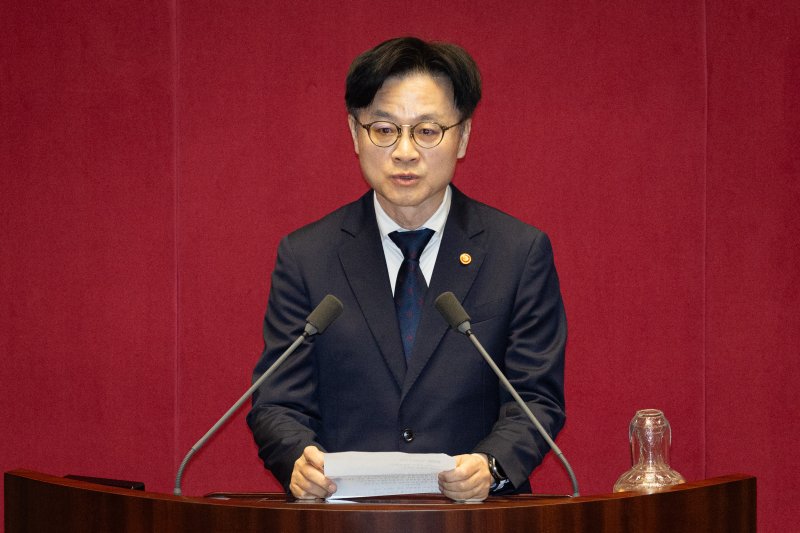
[Financial News] Minister Kim Jeong-gwan of the Ministry of Trade, Industry and Energy recently stated regarding the recently concluded Korea-US trade negotiations, "The increase in automobile tariffs is regrettable, but we will maintain competitiveness with government support." He also countered the 'Free Trade Agreement (FTA) useless theory' raised by some, saying, "You can't just talk about cars," and "There are still many items like ramen that enjoy tariff benefits."
On the 5th, appearing on MBC Radio's 'Kim Jong-bae's Focus,' Minister Kim said, "The United States had a strong stance of applying a 15% tariff on automobiles without exception," and explained, "Since a significant portion of Korea's trade surplus with the US comes from automobiles, there was little room for negotiation in that area."
Nevertheless, he stated, "If it had gone to 25%, it would have been a huge shock to the industry, but adjusting to 15% avoided the worst," and "The gap from 2.5% to 15% will be caught up through government support for R&D or partner and component companies."
Regarding the criticism that the Korea-US FTA is virtually over, he said, "You shouldn't judge it as nullified just by looking at some areas where item tariffs are applied like automobiles," citing ramen as a representative example.
Minister Kim explained, "In the case of Japan, a basic tariff of 6.4% plus an item tariff of 15% is added to ramen, whereas in Korea, due to the FTA, only an item tariff of 15% is applied with a basic tariff of 0%," and "The practical benefits of the FTA still exist and are clearly evident in exports of ramen worth hundreds of millions of dollars."
Regarding the US statement that 90% of the profits from US investment funds go to the US, Minister Kim said, "It's not something that makes sense logically," and "The only thing decided about the fund is what field it will be used in and what scale it will be created." He continued, "The contents of the fund can be in various forms such as loans or guarantees, and how it will be operated in the future needs to be negotiated and specified."
Regarding whether individual company investments are included in the $200 billion, he answered, "It can vary depending on what the project is," and "It may or may not be included in that fund."
Minister Kim emphasized about the shipbuilding industry cooperation (MASGA), which was one of the main cards of this negotiation, "It was a proposal that the US did not expect at all," and "It was a field that received strong responses from the US side."
He explained, "It includes practical investments like the modernization of the 'Philly Shipyard' in Philadelphia, a welding training program for American workers, and solving issues related to merchant ship orders and maintenance (MRO)," and "We created a structure beyond simple investment."
Regarding sensitive issues related to agricultural and livestock products, Minister Kim drew a line saying, "As of now, there is no additional opening of rice or beef." However, he said, "In an era of extreme uncertainty, changes in the situation can occur at any time under the principle of prioritizing national interests."
Regarding whether trade issues will be discussed at the upcoming Korea-US summit, he said, "The agenda has not yet been specified," but "If we specify and raise shipbuilding cooperation contents like MASGA, we can gain an advantageous position in the field of trade cooperation."
[email protected] Park Ji-young Reporter