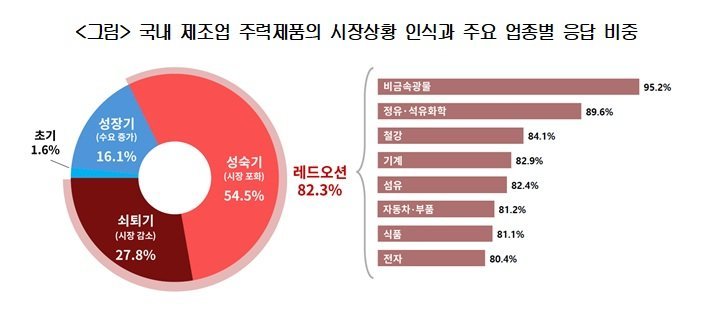
[fn Editorial] 80% of Manufacturing Industry in 'Red Ocean', Urgent Need for Structural Reform and Policy Support
- Input
- 2025-08-04 19:40:03
- Updated
- 2025-08-04 19:40:03
Main products saturated or market declining
Save core companies and transition to advanced industries
Save core companies and transition to advanced industries
In our country, the manufacturing industry, which is the secondary industry, accounts for 27.6% of the total industry, the second highest among OECD member countries. This is based on the 2023 data from the National Assembly Budget Office. It is nearly double the OECD member average (15.8%). The more advanced the economy, the higher the proportion of the service industry, but we have a non-advanced industrial structure with a high proportion of industries that directly produce products.
It is true that the manufacturing industry, led by heavy and chemical industries such as refining, petrochemicals, and steel, has driven our economy so far, but it requires huge facilities and a large workforce. We may face difficulties due to the pursuit of emerging manufacturing countries like China, which have both human and material resources. China, which has been investing heavily in manufacturing revival for 10 years, is pouring out enormous quantities, putting our manufacturing industry in a situation where it must worry about survival. This is because the market has reached saturation, causing prices to drop rapidly.
Industries such as machinery, textiles, automobiles, food, and electronics have also entered the Red Ocean. In a situation where companies are being hit by aggressive investments from countries like China, the high export dependency characteristic of the manufacturing industry means that the U.S. tariff policy is adding insult to injury. Even the automobile industry, which is still relatively doing well, faces a significant threat from the emergence of Chinese cars that offer high quality at low prices.
In this situation, there are several strategies we can take. One is to quickly push for national industrial restructuring for industries whose competitiveness is declining as they enter the Red Ocean. At the same time, more effort should be made to transition the industrial structure to a service industry-centered tertiary industry.
Meanwhile, even within the manufacturing industry, we should reorganize around advanced industries and focus on developing future new growth industries, referred to as 'Blue Ocean (less competitive market)'. Information technology (IT), artificial intelligence (AI), autonomous driving, high value-added semiconductors, and bio are part of some service industries, but they are advanced manufacturing industries and new growth engines that we should nurture.
The next strategy is to save existing core manufacturers while increasing productivity. To do this, automation must be further advanced to reduce labor costs, and efficiency must be increased by incorporating AI. Smaller companies may be more vulnerable in these areas, so government policy and institutional support are essential.
Small and medium-sized enterprises know that pioneering new businesses is the way to survive, but they find it difficult to take on challenges due to the risk burden and lack of financial resources. The government's willingness to roll up its sleeves and do whatever it can, such as providing policy funding and easing regulations, is required. However, seeing the current government's trend, it is regrettable that it is showing an anti-business stance that tightens the noose on companies. If we recognize that companies are the horses pulling the cart of the economy, it is only right to support them generously through various policies.